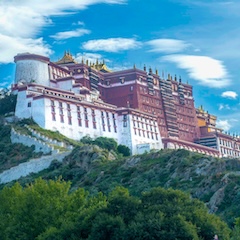
Dechen County
Dechen: Gateway to Sacred Kawa Karpo
Dechen is a Tibetan Autonomous Prefecture in northern Yunnan Province, along with the adjacent counties of Gyalthang and Balung, governed from Kunming. The county extends through the Mekong Gorge south of Tsakalho and includes the Kawa Karpo range (Chinese: Meili), which divides the Mekong from the Salween River. Its eastern boundary is formed by the Yangtze River. The county capital is located in Dechen town.
Historical Background and Demographics
The original names of the town were Jol and Atunzu, but in the 17th century, the Fifth Dalai Lama renamed it and its environs “Dechen,” meaning “supreme bliss.” The town has a population of approximately 9,700, of which the majority are still local Khampa Tibetans.
In the town, the recently constructed Kawa Karpo Lhakhang is a three-story building containing fine murals. The walkway around the ground floor chapel features murals depicting the Eight Medicine Buddhas, the Twenty-One Taras, the Lords of the Three Enlightened Families, and the Three Deities of Longevity.
Monastic Institutions
There is another monastery called Dechen Ling located on a high ridge 4km outside the town, overlooking the valley and the Mekong Gorge. This monastery serves as the residence of Samdong Rinpoche. The monastery itself has recently undergone repairs. A small temple called Jomoling is located higher up the hillside. In the valley below, in the direction of Yuling and Yangkyi, there is another monastery called Homgya Gompa, under the direction of Tropa Guru.
Mt. Kawa Karpo: Sacred Peak of the Tibetan World
Kawa Karpo is one of the most sacred mountains in Tibetan Buddhism, revered as the spiritual home of a warrior god of the same name. It is visited by 20,000 pilgrims each year from throughout the Tibetan world. Many pilgrims circumambulate the peak, an arduous 240km trek. Although it is important throughout Tibetan Buddhism, it is the local Tibetans who serve as the day-to-day guardians and stewards of Kawa Karpo, both the deity and the mountain.
Sacred Geography and Mountain Range
This mighty watershed range has 13 snow peaks forming a north-south alignment. Among them, Mount Kawa Karpo is the highest at 6,740m. To its north is Mount Dradul Wangchuk (6,379m) and to its south is Mount Pawo Pamo (6,000m), followed in succession by the spectacular five-peaked crown of Mount Gyewa Rignga (5,471m), Mount Men Tsunmo (6,055m), and two lesser peaks known as Chugen-Je and Tsela Nyenpo.
Kawa Karpo itself is conceived as a male protector deity, while Men Tsunmo represents the corresponding female consort. The mountain is one of the 25 important meditation sites associated with Padmasambhava in Kham and Amdo. Specifically, this mountain range symbolizes the body-aspect of Buddha-nature.
Religious and Cultural Significance
The ancestral religion of the Kawa Karpo area, as in much of Tibet, was Bon, a shamanistic tradition based on the concept of a world pervaded by good and evil spirits. Bon encompassed numerous deities and spirits that are still recognized today and are often connected with specific geographical localities and natural features. The major mountain peaks in the Hengduan Mountains are thus all identified with specific deities, and Kawa Karpo is one of these. Since its introduction, Tibetan Buddhism has been the dominant religion of the Kawa Karpo area, with followers of Gelugpa doctrine being the most common.
Sacred Preservation and Environmental Protection
Tibetans believe the warrior god will abandon them if humans set foot on the peak of Kawa Karpo, making the ground unholy. Disasters will follow as they lose the god’s protection. Tibetans have also established a centuries-old sacred geography around the peak, maintained by religious leaders from local monasteries in negotiation with local villages. This sacred natural site preserves the natural resources and ecological health of the range.
A Living Sacred Landscape
Dechen and the Kawa Karpo range represent one of the most successful examples of traditional Tibetan environmental conservation, where religious beliefs and cultural practices have created effective protection for one of Asia’s most biodiverse mountain ecosystems. The integration of spiritual reverence with ecological stewardship demonstrates the profound wisdom embedded in Tibetan approaches to landscape management.
Search
Upcoming Tours
Recent Posts
- Mount Kailash Kora updates
 September 26, 2026
 - Tibet Travel Permits
 September 24, 2026
 - Update on China / Tibet–Nepal Land Border Crossings
 September 24, 2026
For More Information
Newsletter
Explore more! Join to get updates on Tibet tours and departures.
We are recommended by
We are committed to providing authentic, high quality, environmentally sustainable travel services. Join us and experience once in a lifetime holiday.
Contact Information
Recent Trips
.jpg "amdo monlam festival tour")