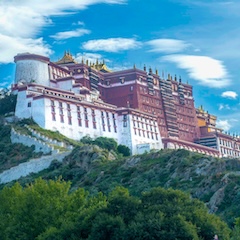
Ragya Monastery
Ragya Monaster: The Geluk Stronghold of Golog
Ragya Monastery stands majestically on the banks of the Yellow River, 345km southwest of Xining and 100km east of Maqin (Machen) County in Golog Tibetan Autonomous Prefecture, Qinghai Province. Nestled within a dramatic red clay canyon valley, this imposing complex serves as the largest Gelug monastery in the Golog region, commanding both spiritual authority and geographical prominence in one of Amdo Tibet’s most rugged landscapes.
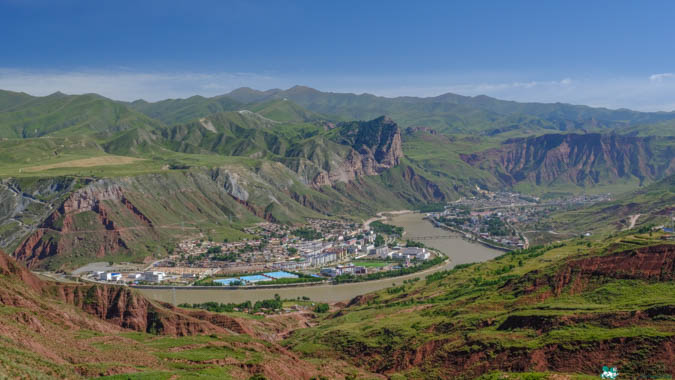
The overview looking of Ragya Monastery in Golog.
Historical Foundation and Spiritual Lineage
Originally known as Tashi Kundeling, Ragya Monastery was established in 1769 as an important branch of the prestigious Sera Monastery in Lhasa. The monastery’s foundation came on the advice of the Seventh Dalai Lama and was realized through the efforts of Arik Geshe, a Mongolian from the Kokonor (Qinghai Lake) region whose vision would create one of eastern Tibet’s most significant religious institutions.
The monastery’s spiritual lineage gained extraordinary significance through its second preceptor, Shingza Pandita Lobsang Dargye, who is revered as an incarnation of Shingza Acho – the mother of Je Tsongkhapa, founder of the Gelug school. This profound connection to Tsongkhapa’s family lineage has elevated Ragya’s spiritual status, and subsequent incarnations of Shingza Pandita have continued to preside over the monastery, maintaining an unbroken line of blessed leadership.
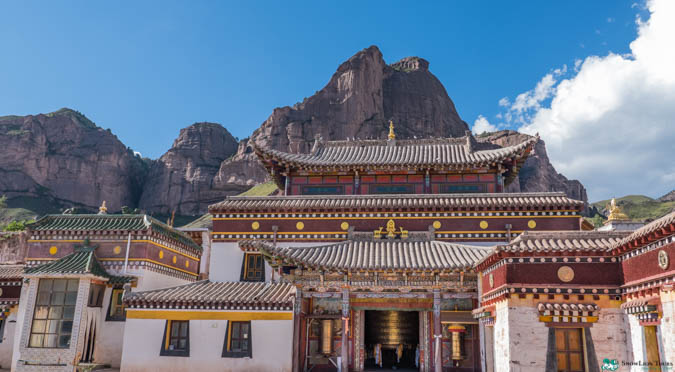
The gate temple of Ragya Monastery in Golog.
Architectural Renaissance and Sacred Spaces
Following extensive reconstruction over the past two decades, Ragya Monastery now presents a harmonious blend of traditional Tibetan architecture and modern restoration techniques. The complex’s layout reflects classical monastic design principles while accommodating contemporary educational and spiritual needs.
The Main Assembly Hall dominates the center of the complex, featuring an impressive trilingual inscription above its entrance that speaks to the monastery’s multicultural heritage. The hall’s interior showcases 64 intricately carpeted pillars supporting a soaring ceiling, while the original flagstone floor bears witness to centuries of devotional practice. The inner sanctum houses sacred images of Amitabha Buddha, founder Arik Geshe, the Buddhas of the Three Times, Tara, and Akshobhya, alongside the complete volumes of the Kangur (translated teachings of Buddha).
Menpa Dratsang (Medical College) occupies the left side of the complex, containing a throne bearing the portrait of Alak Yongdzin of Tarshul Monastery, images of the Eight Medicine Buddhas, and representations of the Lords of the Three Enlightened Families – emphasizing the monastery’s commitment to traditional Tibetan healing arts.
Dukhor Dratsang (Kalachakra College) stands to the right, dedicated to the study and practice of the Kalachakra tantra, one of Buddhism’s most sophisticated philosophical and meditation systems.
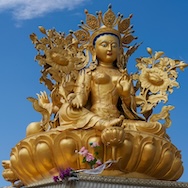
Higher up the hillside, the newly constructed Dungten Lhakhang (Reliquary Temple) houses the sacred remains of the late Je Serkhangpa of Ragya, while a magnificent large statue of Je Tsongkhapa watches over the entire valley, serving as both spiritual focal point and artistic masterpiece.
Sacred Geography and Pilgrimage Sites
The monastery’s setting within the landscape holds deep spiritual significance. The broad cliff rising behind Ragya is known as Mount Khyungon (Blue Garuda), named after the mythical bird-like creature that serves as a vehicle for divine beings in Tibetan cosmology. The pilgrimage walk to the hilltop shrine passes several smaller shrines and meditation caves, offering practitioners both spiritual merit and spectacular panoramic views of the Yellow River winding through the red canyon landscape.
This sacred geography transforms the entire area into a three-dimensional mandala, where the natural landscape, architectural elements, and spiritual practices combine to create a powerful environment for contemplation and realization.
Educational Innovation: Ragya School
In a remarkable demonstration of educational entrepreneurship, the monastery complex includes the innovative Ragya School, founded by Tibetan monk entrepreneur Jigme Gyantsen, who also operates a successful Tibetan cheese factory. This groundbreaking institution represents a new model for non-governmental education in Tibet.
The school operates with a progressive dual-education system: one division serves monks and male students, while a separate facility caters to nuns and female students. This inclusive approach ensures that both traditional monastic education and modern secular learning opportunities are available to all community members regardless of gender.
The school’s success has been remarkable, with graduates gaining admission to universities and colleges throughout Qinghai Province and beyond. This educational model demonstrates how traditional Tibetan institutions can adapt to contemporary needs while maintaining their cultural authenticity, providing a template that other communities across the Tibetan plateau have begun to emulate.
Cultural and Economic Impact
Ragya Monastery serves as more than a religious institution – it functions as the cultural and economic heart of the broader Golog region. The monastery’s influence extends through its educational programs, traditional craft workshops, and the innovative business ventures of its members, creating a sustainable model for preserving Tibetan culture while engaging with the modern economy.
The integration of traditional monastic life with contemporary educational and business practices at Ragya represents a sophisticated approach to cultural preservation that addresses both spiritual needs and practical realities facing Tibetan communities in the 21st century.
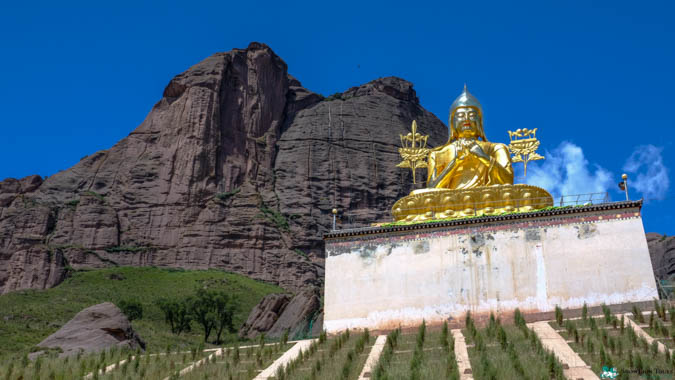
The Je Tsongkhapa’s Statue in Ragya Monastery in Golog.
A Living Bridge Between Tradition and Modernity
Ragya Monastery stands as a powerful testament to the adaptability and resilience of Tibetan Buddhist institutions. From its 18th-century foundations through its recent architectural renaissance to its pioneering educational initiatives, the monastery demonstrates how ancient wisdom traditions can evolve to meet contemporary challenges without losing their essential character.
Set against the dramatic backdrop of the Yellow River canyon, with its red cliffs rising toward the sacred peak of Mount Khyungon, Ragya Monastery continues to serve as a beacon of learning, spirituality, and innovation in one of Tibet’s most spectacular and culturally significant regions. The monastery’s success in balancing traditional monastic life with modern educational excellence offers hope and inspiration for Tibetan communities worldwide seeking to preserve their heritage while embracing the opportunities of the contemporary world.
Ragya School
This is a school founded by Tibetan monk entrepreneur Jigme Gyantsen who also own Tibetan Cheese factory. This school has two sub-schools, one for monks and male students and the other one is for nuns and female students. This school is aimed to be the model of non-government school which raised many students all over the universities and colleges in Qinghai and other provinces.
Recent Posts
- Mount Kailash Kora updates
 September 26, 2026
 - Tibet Travel Permits
 September 24, 2026
 - Update on China / Tibet–Nepal Land Border Crossings
 September 24, 2026
Related Tours
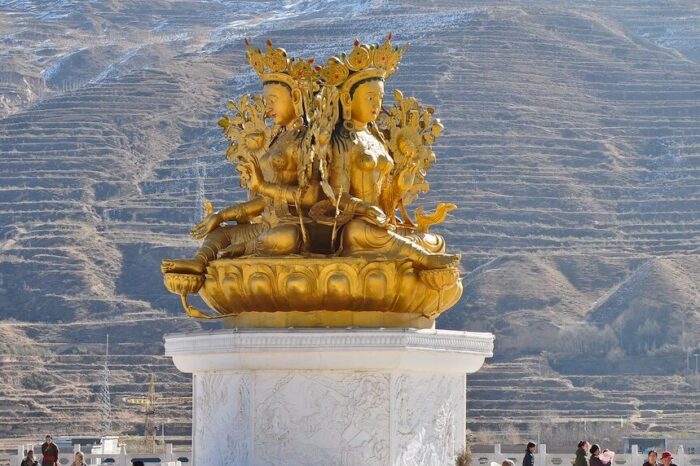
4 Days Winter Tour in Qinghai
This 4-day winter tour is one of the best tours in Qinghai Province during the winter season. It offers a great opportunity to see Qinghai's most beautiful places such as Guide, Rebkong and Kanbula National …
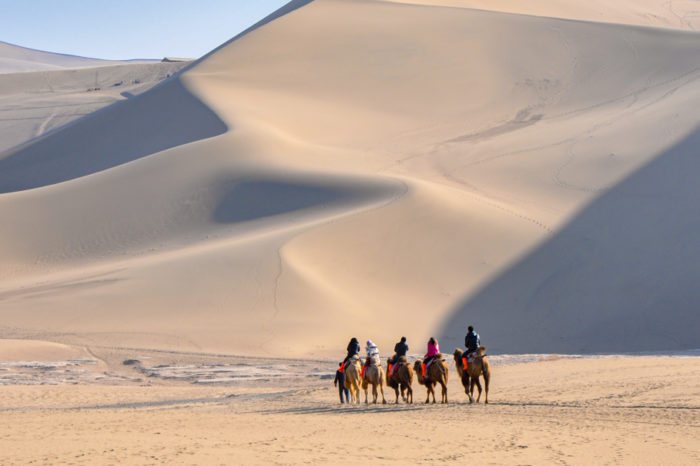
Silk Road Tour
The Ancient Silk Road, an intricate network of trade and cultural exchange pathways, served as a vital connection between the East and the West for merchants, pilgrims, soldiers, princes, nomads, and other intrepid adventurers. At …
We are recommended by
We are committed to providing authentic, high quality, environmentally sustainable travel services. Join us and experience once in a lifetime holiday.
Recent Trips
.jpg "amdo monlam festival tour")