Tradition tells that during the life of the historical Buddha, Śākyamuni, a young Brahmin boy made an offering to him of a crystal rosary. For this, the Buddha blessed him and prophesied that he would one day be reborn in Tibet where he would assist in spreading the Buddha’s teachings. In order to aid the boy’s future rebirth, the Buddha ordered one of his followers, the Arhat Maudgalyāyana, to travel to Drogri Mountain and bury a sacred conch which had been given to the Buddha by Anavatapta, the King of the Nāgas.
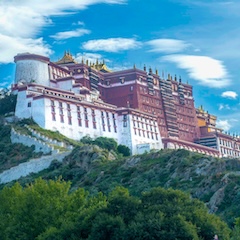
Nestled atop a ridge on Drogri Mountain is Ganden Monastery.
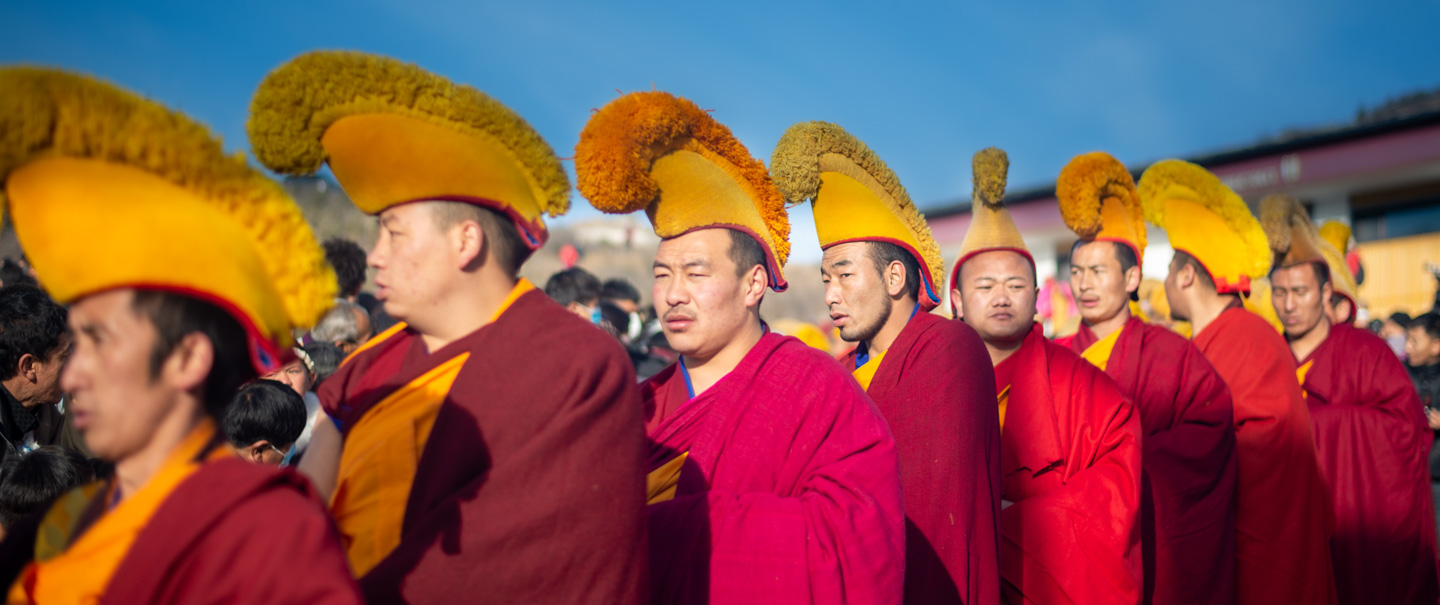
Centuries later, this conch was said to have been unearthed on the slopes of Drogri Mountain by a Tibetan teacher, Je Tsongkhapa. It was there that his followers built him a monastery so that he would not be forced to travel long distances in order to perform the Monlam Chenmo prayer festival in nearby Lhasa. Sanctifying it with the name Ganden, the Tibetan form of Tushita—the heaven where the future Buddha, Maitreya, is residing—the monks who inhabited it originally called themselves Gandenpa.
The main statue in the Ganden Monastery in Lhasa.
As the disciples of Tsongkhapa codified his teachings and began to form new monasteries following his death in 1419, the Gandenpa soon took on a new name in order to differentiate themselves from other traditions of Tibetan Buddhism. They called themselves the Gelugpa, the Virtuous Ones.
Tsongkhapa was born in 1357 in Tsongkha, a valley in the Amdo region of Qinghai. Initially he received the name Kunga Nyingpo from the Fourth Karmapa, Rolpai Dorje (1340–1383), with whom he made his novice vows. Upon his ordination he received the name Lobsang Drakpa from a Kadampa lama, Chöjé Döndrup Rinchen. At age sixteen, after completing his studies with Chöjé Döndrup Rinchen, Tsongkhapa left Amdo for the Ü-Tsang region of Central Tibet.
There he studied under a variety of masters from different traditions of Tibetan Buddhism. During this time, he was largely influenced by the works of the Indian scholar Atiśa, whose teachings had been continued by the Kadam tradition. Studying at Sakya, he also fell under the tutelage of the renowned Sakya teacher Rendawa Zhonnu Lodrö (1349–1412). It was Rendawa’s teachings which steered Tsongkhapa towards formulating his own interpretation of the Prāsaṅgika Madhyamaka philosophy.
Having trained in the scholastic traditions of the Kadam and Sakya, Tsongkhapa soon began to write his own commentaries on the subject of Madhyamaka. Concerned that he had not truly penetrated the understanding of emptiness as taught by Prāsaṅgika Madhyamaka, Tsongkhapa entered into communication with the Bodhisattva of Wisdom, Mañjuśrī, with the assistance of a Kagyüpa lama, Umapa Pawo Dorje. Yet it wasn’t until 1398 that he achieved full insight into Madhyamaka, after receiving a vision of the Indian teachers of this philosophy. In 1402 he wrote the Lamrim Chenmo, which has since been considered one of his seminal works.
As well as a concern for clarifying the final interpretation of Prāsaṅgika Madhyamaka, Tsongkhapa reinforced a strong emphasis on adherence to the monastic code, the Vinaya, and the vow of celibacy. For him, these were the necessary requirements to be undertaken before a monk could progress to the study and performance of tantra.
Tsongkhapa’s clarification of Tibetan monasticism and scholasticism attracted many followers. After his death in 1419, his disciples continued to spread his teachings throughout the Ü region of Central Tibet. New monasteries, such as Sera and Drepung, were founded, and together with Ganden they came to form the core institutions of the newly emerged Gelug tradition. Eventually Gelug monasteries were established in Tsang, Kham, and Amdo.
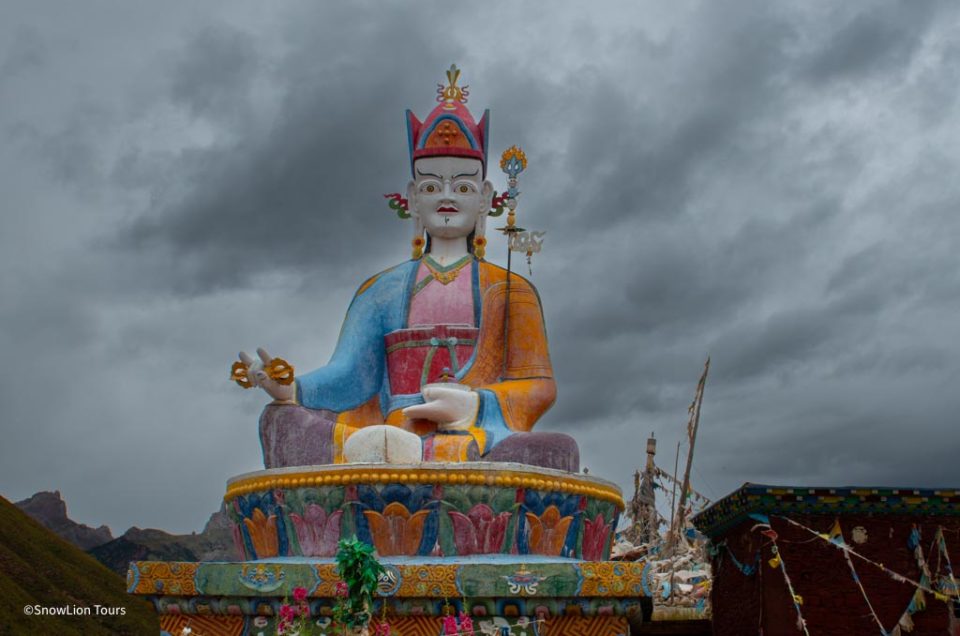
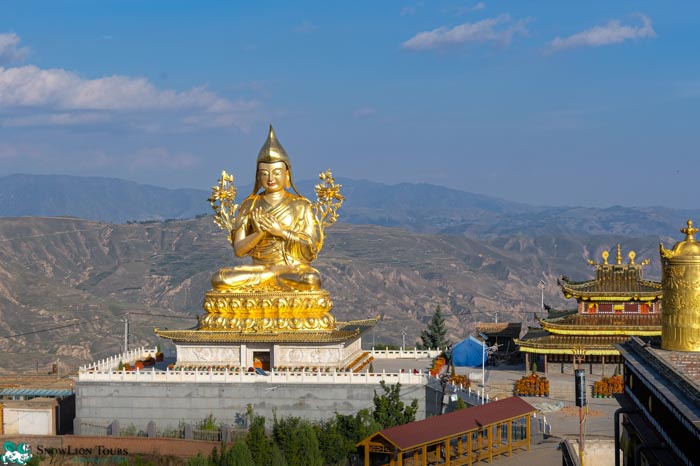
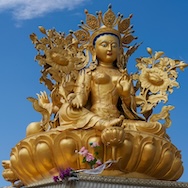
Tsongkhapa’s statue in Shachung Monastery in Amdo, Tibet.
As the Gelug tradition developed and took hold, Tsongkhapa came to be revered as an emanation of Mañjuśrī. Although he originally had many disciples, over time Khedrup Je Gelek Pelzang (1385–1438) and Gyeltsab Je Darma Rinchen (1364–1432) came to be considered his primary students. Today, in depictions of Tsongkhapa, you will always see him accompanied by them.
In the centuries following Tsongkhapa’s death, the popularity of the Gelug teachings led to the tradition coming into conflict with other schools of Tibetan Buddhism and their secular allies. The Gelugpa eventually sought assistance from various groups of Mongols, with whom their teachings had become popular through the efforts of the Third Dalai Lama, Sonam Gyatso (1543–1588). Yet it wasn’t until the reign of the Fifth Dalai Lama, Ngawang Lobsang Gyatso (1617–1682), that the Gelug became the dominant tradition.
The tradition spread beyond the borders of Tibet and became the dominant tradition of Buddhism for the Mongols, including the Kalmyks who migrated to European Russia in the seventeenth century. Through the efforts of Mongol missionaries, it also spread to the Buryats of Siberia.
It was Tsongkhapa’s homeland, Amdo, which was to become the stronghold of the Gelug, and there it founded many important monasteries, including Kumbum Jampa Ling. This monastery was founded in 1560 and developed from a shrine dedicated to the spot where blood from Tsongkhapa’s umbilical cord was said to have fallen to the ground. Other influential Gelug monasteries in the region include Gonlung and Labrang.
Kumbum Monastery, the birthplace of Je Tsongkhapa in Amdo, Tibet.
Because of the importance it places on scholasticism, a structured curriculum supported by debate became a core feature of the Gelug tradition. Traditionally, monks from the various regions where the Gelug tradition had spread would travel to Lhasa in order to study at one of the three seats—Ganden, Drepung, and Sera. After completing a rigorous and lengthy course of study, these monks were then able to receive the academic title of geshe.
Je Tsongkhapa was a remarkably prolific scholar and tantric adept whose writings span the full breadth of Tibetan Buddhist philosophy and practice. Here’s a structured overview of his major works.
- Lamrim Chenmo (The Great Treatise on the Stages of the Path to Enlightenment)
- Completed in 1402, this is Tsongkhapa’s most celebrated text. It’s a comprehensive guide to Mahayana practice—covering the development of bodhicitta (the altruistic mind of enlightenment), the six perfections, and the meditative practices of shamatha and vipashyana .
- Ngagrim Chenmo ( The Great Exposition of Secret Mantra)
- Composed around 1405, this foundational work synthesizes practices across all four classes of Tantra. It served as the basis for instituting tantric education in the Gelug tradition .
- Essence of True Eloquence ( Drang Nges Legs Bshad Snying Po)
- Written in 1407, this is a hermeneutical work elucidating Madhyamaka philosophy and clarifying subtle doctrinal points .
- Ocean of Reasoning (Rigs Pa’i Rgya Mtsho)
- Completed circa 1408, this is a detailed commentary on Nagarjuna’s Mūlamadhyamakakārikā, exploring the nature of emptiness with philosophical rigor .
- Illumination of the Meaning of the Middle Path
- A commentary on Candrakirti’s Madhyamakavatara, continuing Tsongkhapa’s systematic exposition of Madhyamaka .
- A Lamp to Illuminate the Five Stages ( Guhyasamāja Commentary)
- Written in 1411, this is one of the most authoritative commentaries on the Guhyasamāja Tantra and remains central to Gelug tantric scholasticism .
- Golden Garland of Eloquence (Gser Phreng)
- A commentary on the Abhisamayālaṃkāra, composed in the late 1380s. It’s an important text in the Gelug interpretive tradition .
- The Praise of Relativity
- A shorter work exploring dependent origination—an essential Mahayana teaching that Tsongkhapa often emphasized .
Writings on Tantra & Meditative Practice
- Tsongkhapa also wrote on various Tantras such as Vajrabhairava, Cakrasaṃvara, and Kalacakra, though his most enduring influence remains his Guhyasamāja commentary .
- Additionally, he composed a commentary on the Six Yogas of Nāropa, offering structured guidance on practices like inner heat (tummo), dream yoga, and consciousness transference .
Scope and Legacy of His Works
- Tsongkhapa’s collected writings amount to some 18 volumes, containing hundreds of titles. A traditional block-print edition catalogues over 210 individual works .
- The influential Stanford Encyclopedia highlights several key texts and notes how his works were widely published as woodblock prints soon after his death, forming part of the Father and Sons Collected Works (rJe yab sras gsum gyi gsungs’ bum) by the early 16th century .
Summary Table
| Genre | Key Texts |
| Comprehensive Path | Lamrim Chenmo, Ngagrim Chenmo |
| Philosophical Madhyamaka | Essence of True Eloquence, Ocean of Reasoning, Illumination of the Middle Path |
| Tantric Practice | A Lamp to Illuminate the Five Stages, Six Yogas of Nāropa commentary |
| Shorter Works / Devotional | Golden Garland of Eloquence, Praise of Relativity |
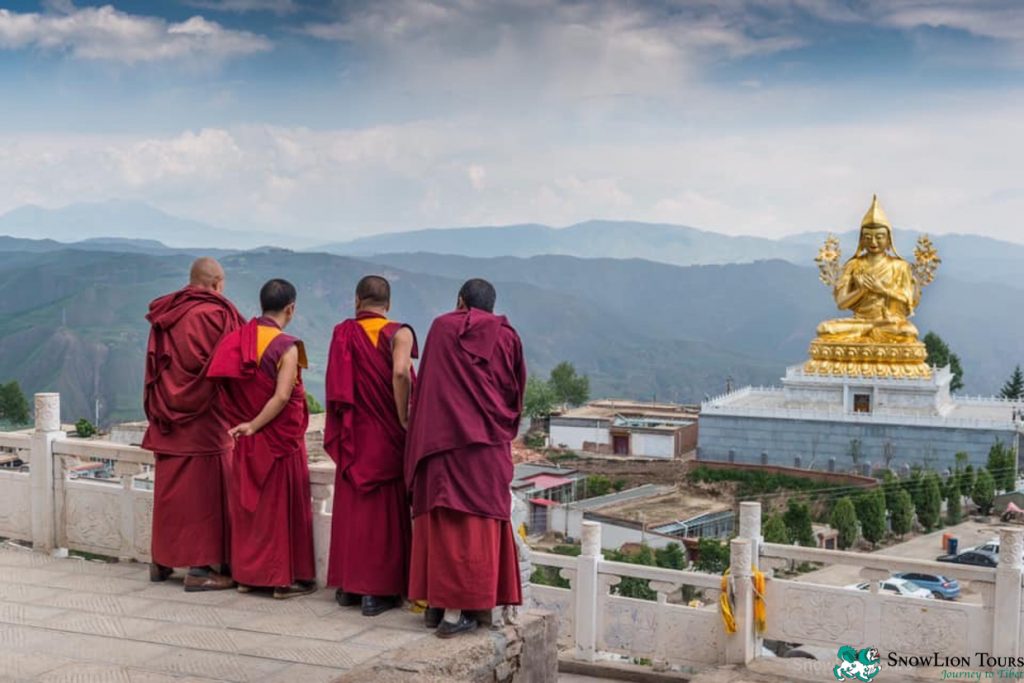
Tsongkhapa’s statue in Shachung Monastery in Amdo Tibet


.jpg "amdo monlam festival tour")