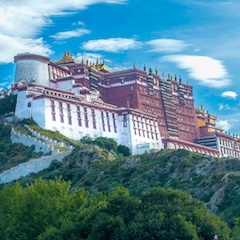
Gonlung Monastery
Gonlung Monastery is also called Youning Si in Chinese. This once-largest monastery in the region of Amdo Tibet lies against a rocky mountain about 23 km southeast of Huzhu County and 65 km northeast of Xining in Qinghai Province. Gonlung […]
Gonlung Monastery is also called Youning Si in Chinese. This once-largest monastery in the region of Amdo Tibet lies against a rocky mountain about 23 km southeast of Huzhu County and 65 km northeast of Xining in Qinghai Province.
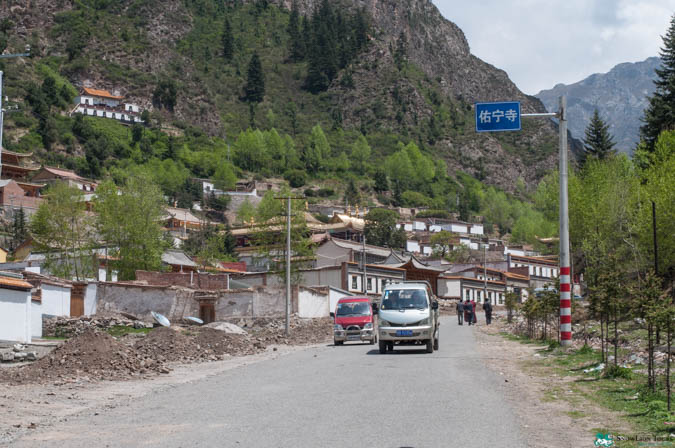
Golung Monastery
Gonlung Jampa Ling is an important Gelug monastery in Amdo that was founded in 1604 by Gelse Donyo Chokyi Gyatso. The site was visited by the Third Dalai Lama and Fourth Dalai Lama prior to its founding. It is regarded as one of the four great monasteries north of the Zongchu River.
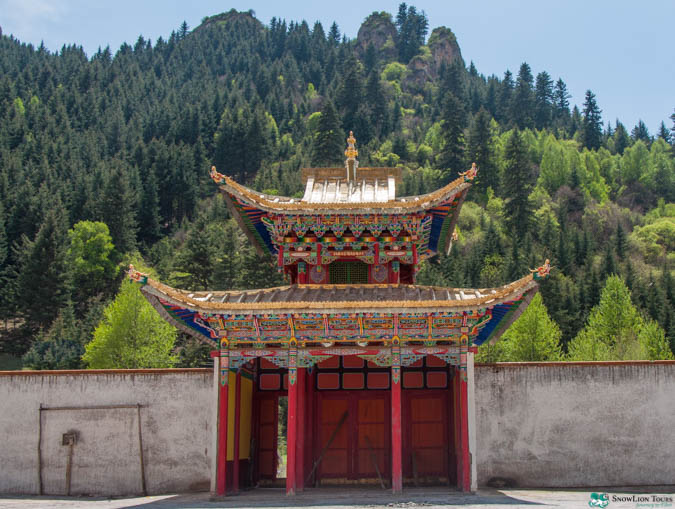
The main gate of Gonlung Monastery in Qinghai.
It is the seat of the Changkya and Tukwan incarnations. The monastery now houses monks of Tu (Monguor), Tibetan, and Mongolian origin. Though destroyed in 1724 during the reign of Lhazang Khan and rebuilt in 1732, it was partially destroyed during the Cultural Revolution, and reconstruction of the monastery began in 1980.
Once there were 700 monks at its peak; however, this was completely destroyed during the Cultural Revolution. Only one temple is left from the old monastery to serve as a storage room. Today it is well-known for its New Year’s festival as well as masked dance ceremonies that are held twice a year. Here the Tu minority people, who are of Turkic origin but practitioners of Tibetan Buddhism, are to be found in one of their greatest concentrations. Most wear regular Western-style clothes, but you will find older people of Tu ethnicity, especially Tu women, still wear their traditional Tu dress with green and red stripes on top in the villages around Gonlung Monastery.
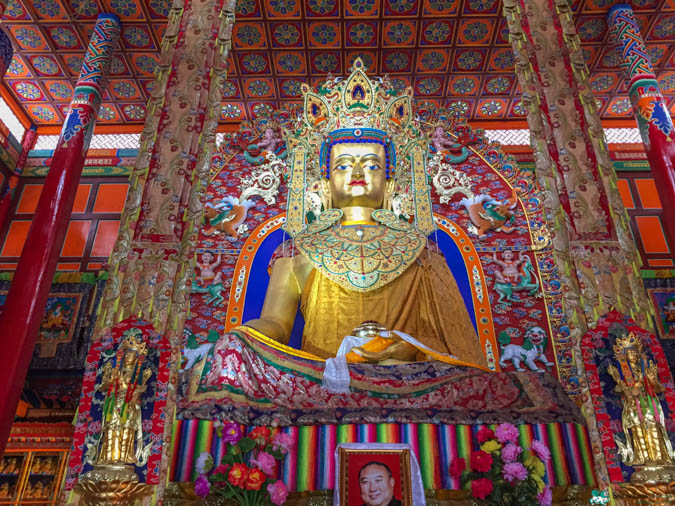
The Buddha Shakyamuni’s Statue in Gonlung Monastery.
This monastery’s top lama has an interesting history, so here I will take several lines to explain why.
Changkya Rolpe Dorje is the main lama of the monastery and was born on the 10th day of the fourth (Hor) month of the Fire-Bird year (1717) in Wuwei (formerly known as Liangzhou) near Lanzhou in Gansu. At an early age, he was recognized by the first Jamyang Zhepa as the incarnation of the previous Changkya Kutuktu of Gonlung Jampa Ling Monastery. At his investiture, the Kangxi Emperor sent Kachen Sherap Dargye as his representative.
In 1723, soon after the death of Kangxi, the new ruler Yongzheng was just establishing his authority when Mongol tribesmen claiming the succession of Gushi Khan, together with their Amdo Tibetan allies and supported by some factions within the monasteries, rose up against the Qing in the region of Kokonor. Yongzheng insisted on violent reprisals, and in Amdo the Manchu army destroyed villages and monasteries believed to have sided with the rebels.
However, the emperor ordered that the seven-year-old Changkya incarnation not be harmed but brought to China as a “guest.” At the Yongzheng Emperor’s court, he was raised and educated to serve as an intermediary between the seat of Manchu power and the Buddhists of Amdo, Tibet, and Mongolia. Rolpe Dorje’s monastic teachers included Zhangshu Kachen Sherap Dargye, the second Thuken Hotogtu Ngakwang Chokyi Gyatso, and Atse Choje Lozang Chodzin.
Changkya Rolpe Dorje and his teachers realized that in order for the Gelug teachings to flourish in China and Manchuria, they would need to be available in Chinese, Mongolian, and Manchu, and so he began the study of those languages. One of his fellow students was Prince Hungli, who became his friend and eventually the Qianlong Emperor. He also took an interest in Chinese Buddhism and thought that their principal philosophical views had close similarities with those of the Yogachara school. He was also apparently the one who came up with the notion that Dampa Sangye, the Indian founder of the Pacification school in Tibet who supposedly also visited China, and Bodhidharma were the same person.
Located in an evergreen forest at the foot of snow mountains, Gonlung Jampaling is a rare gem that few tourists visit. The monastery is a major pilgrimage site along the northern Zongchu River. There is great hiking in the area, and the monastery has many ancient thangka paintings of interest to art lovers.
There are several famous meditation caves in this place, including those of Indian Master Atisha, Karmapa, as well as some other famous figures in Tibetan Buddhism. The highest cave has some blessed water dropping from the cave cliffs, which is considered the nectar of this meditation cave. Local people even collect it in bottles to bring home.
There are two routes to get to this monastery from Xining. You can either drive from Ping’an, which is 33 km to the northeast, or 23 km to the southeast of Huzhu County.
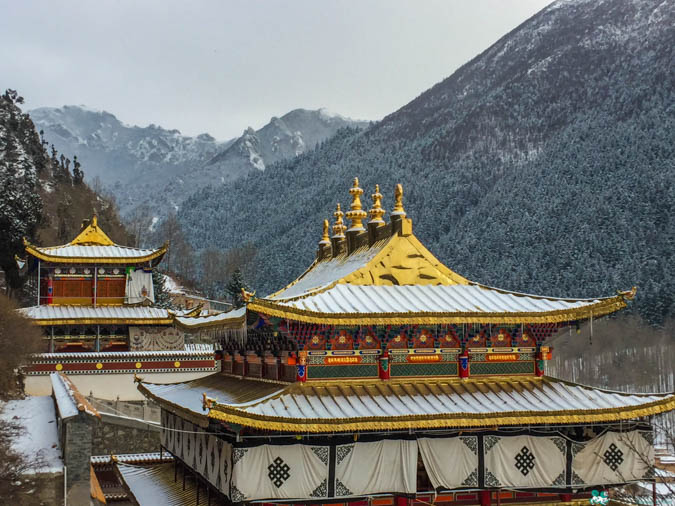
Gonlung Monastery in winter
In 1723, soon after the death of Kangxi, the new ruler Yongzheng was just establishing his authority when Mongol tribesmen claiming the succession of Gushi Khan, together with their Amdo Tibetan allies and supported by some factions within the monasteries, rose up against the Qing in the region of Kokonor. Yongzheng insisted on violent reprisals, and in Amdo the Manchu army destroyed villages and monasteries believed to have sided with the rebels.
However, the emperor ordered that the seven-year-old Changkya incarnation not be harmed but brought to China as a “guest.” At the Yongzheng Emperor’s court, he was raised and educated to serve as an intermediary between the seat of Manchu power and the Buddhists of Amdo, Tibet, and Mongolia. Rolpe Dorje’s monastic teachers included Zhangshu Kachen Sherap Dargye, the second Thuken Hotogtu Ngakwang Chokyi Gyatso, and Atse Choje Lozang Chodzin.
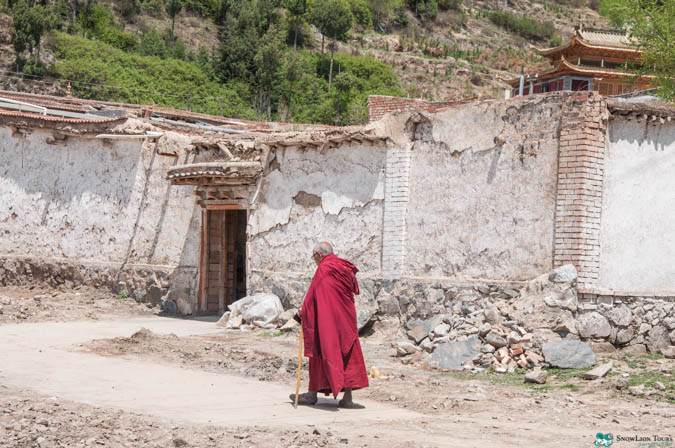
A monk is heading to his resident in Gonlung Monastery.
Changkya Rolpe Dorje and his teachers realized that in order for the Gelug teachings to flourish in China and Manchuria, they would need to be available in Chinese, Mongolian, and Manchu, and so he began the study of those languages. One of his fellow students was Prince Hungli, who became his friend and eventually the Qianlong Emperor. He also took an interest in Chinese Buddhism and thought that their principal philosophical views had close similarities with those of the Yogachara school. He was also apparently the one who came up with the notion that Dampa Sangye, the Indian founder of the Pacification school in Tibet who supposedly also visited China, and Bodhidharma were the same person.
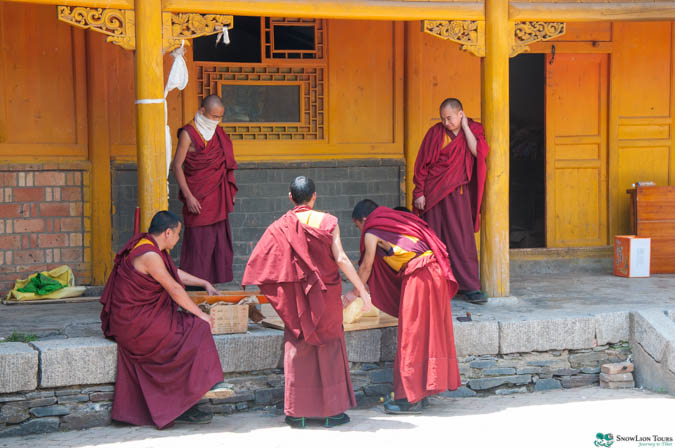
Monks are preparing ritual in Gonlung Monastery.
Located in an evergreen forest at the foot of snow mountains, Gonlung Jampaling is a rare gem that few tourists visit. The monastery is a major pilgrimage site along the northern Zongchu River. There is great hiking in the area, and the monastery has many ancient thangka paintings of interest to art lovers.
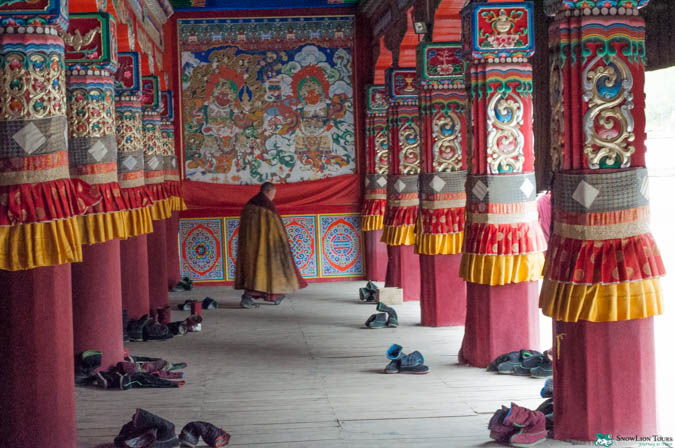
A monk came out of assembly hall in Gonlung Monastery.
There are several famous meditation caves in this place, including those of Indian Master Atisha, Karmapa, as well as some other famous figures in Tibetan Buddhism. The highest cave has some blessed water dropping from the cave cliffs, which is considered the nectar of this meditation cave. Local people even collect it in bottles to bring home.
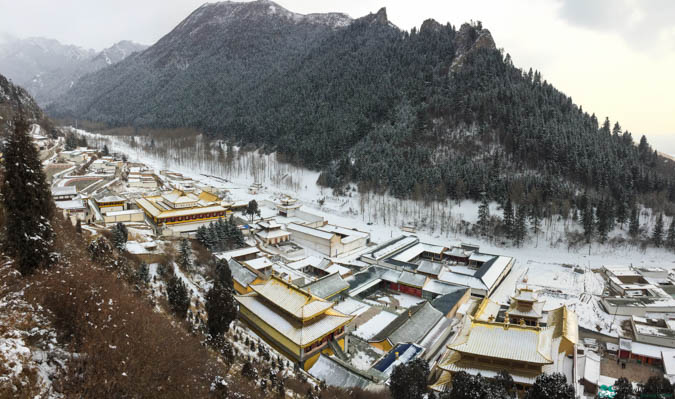
Gonlung Monastery overview in winter
There are two routes to get to this monastery from Xining. You can either drive from Ping’an, which is 33 km to the northeast, or 23 km to the southeast of Huzhu County.
There are several famous Meditation caves in this place including Indian Master Atisha, Karmapa as we ll as some other famous figures in Tibetan Buddhism. The highest cave has some bless water dropping from the cave cliffs which considered the nectar of this mediation cave. Local people even collect it in the bottles to bring home.
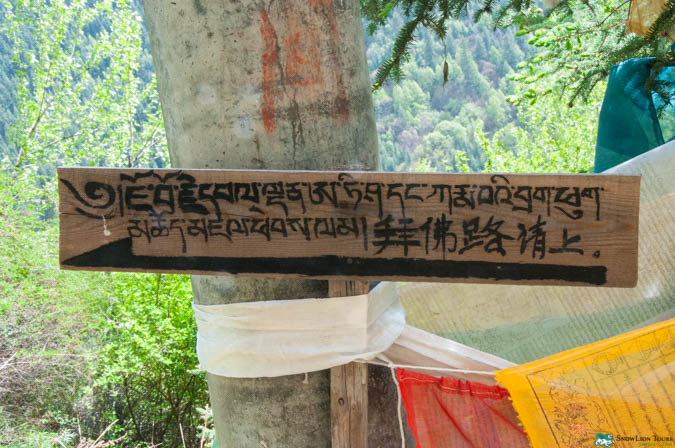
The wooden plate instruct how to get to Atisha and Karmapa’s caves in Gonlung Monastery.
Recent Posts
- Shoton Festival Begins in Lhasa!
 August 23, 2025
 - Tour Price in Tibet
 August 23, 2025
 - Qinghai Shaman Festival in Rebkong Concludes Successfully
 August 21, 2025
Related Tours
Discover Qinghai
Discover Kumbum Monastery, Qinghai Lake, Mount Amnye Machen, Kanbula Park, and enjoy guided insights on this unforgettable Qinghai cultural and scenic tour.
Best Qinghai Tour
There are many interesting places just outside of Xining city and other major towns in Qinghai. This itinerary specifically design for travelers who are interested in photograph with stunning landscape and wildlife in Qinghai Province …
Amdo Overland Journey
The Tibetan Plateau, located to the north of the Himalayas, is often referred to as “The Roof of the World.” The Tibetan cultural region is roughly the size of Western Europe, though the Tibet Autonomous …
We are recommended by
We are committed to providing authentic, high quality, environmentally sustainable travel services. Join us and experience once in a lifetime holiday.
Recent Trips
.jpg "amdo monlam festival tour")