Gurla Mandhata
The Sacred Goddess Peak of Western Tibet
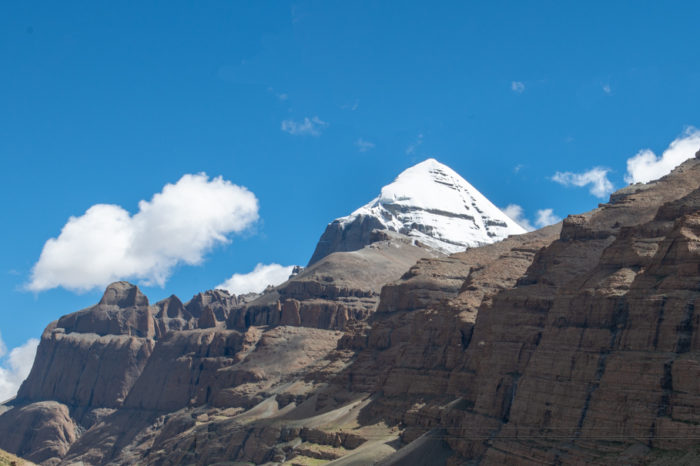
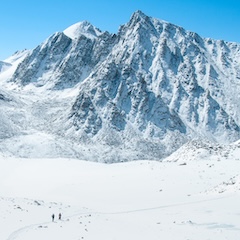
Gurla Mandhata, known locally as Naimona’nyi (གནས་མོ་སྣ་གཉིས།) or Namu Nani, stands as one of the most majestic and sacred peaks in the Himalayas. Rising to 7,694 meters (25,354 feet), this imposing mountain is revered by Tibetans as the “Mountain of the Holy Mother” or “Goddess Peak,” embodying the divine feminine principle in the sacred geography of western Tibet.
Located in what is now administered as Burang County in the Ngari Prefecture of the Tibet Autonomous Region, Gurla Mandhata occupies a position of profound geographical and spiritual importance. The mountain sits across Lake Manasarovar from the sacred peak of Mount Kailash, approximately 100 kilometers apart, creating a powerful spiritual dyad that has drawn pilgrims for centuries.
Despite their proximity, these two sacred mountains belong to different ranges: Gurla Mandhata is part of the Himalayas’ Nalakankar Himal subrange, while Mount Kailash belongs to the Gangdise Mountains (Trans-Himalaya). This distinction adds to their complementary nature in Tibetan cosmology.

Tibetan Understanding
In Tibetan tradition, the name Naimona’nyi carries deep meaning. According to local interpretation: “Naimo” means “herb,” “Na” means black, and “Nyi” refers to the steep slope of accumulation. Thus, the full name translates to “the mountain peak formed by the accumulation of black herbs on the steep slope.” This etymology reflects the Tibetan understanding of the mountain as a source of medicinal plants and spiritual healing.
Sanskrit and Hindi Origins
The name “Gurla Mandhata” derives from Sanskrit गन्धमादन (Gandhamadana), supposedly originating from a pass near the mountain. This connects the peak to ancient Indian sacred geography and pilgrimage traditions.
Mythological Significance
Tibetan legend personifies the mountain as Namunani, the beautiful Himalayan daughter whose tragic love story with Gang Rinpoche (Mount Kailash) resulted in her transformation into a solitary snow peak. This mythological narrative adds a layer of romantic mystique to the mountain’s spiritual significance.
Elevation and Ranking
Standing at 7,694 meters, Gurla Mandhata ranks as the 34th highest peak in the world using a 500-meter prominence cutoff. It holds the distinction of being the fifth goddess among the Five Goddess Mountains of the Himalayas and the highest peak in the Ngari region.

Mountain Structure
The mountain covers approximately 200 square kilometers and features six main ridges with dozens of peaks above 6,000 meters. The western ridges are arranged in a fan shape from north to south, while the eastern ridge has been sculpted by erosion into a dramatic blade ridge, creating nearly vertical cliffs with a height difference of almost 2,000 meters.
Glacial System
Gurla Mandhata hosts an extensive glacial system with 58 glaciers covering 79.81 square kilometers. Most are valley glaciers and cirque valley glaciers, with five major glaciers flowing through canyons on the western slopes. The ice surfaces are characterized by crevasses and ice cliffs, creating a challenging mountaineering environment.
Mountaineering History and Challenges
Early Attempts
The first recorded attempt on Gurla Mandhata was made in 1905 by British climber T.G. Longstaff with two alpine guides and six porters. After suffering a 900-foot fall during an avalanche, they reached approximately 7,000 meters before being turned back by heavy snowfall. This represented a world altitude record at the time, when no summit over 7,000 meters had yet been climbed.
Notable Expeditions
- 1935: Austrian student Herbert Tichy, disguised as an Indian pilgrim, attempted the peak with porter Kitar, reaching 7,100 meters before weather forced retreat.
- 1955: The Welsh Himalayan Expedition intended to summit Gurla Mandhata but was captured by Chinese military before the climb could begin.
- 1985: The first successful ascent was achieved by a joint Sino-Japanese team led by Katsutoshi Hirabayashi via the north face route.
Modern Climbing
Since the first ascent, only a handful of successful climbs have been completed, making Gurla Mandhata one of the least climbed major peaks. The standard route follows the northwestern slopes via the Zalompa Glacier, while alternative routes from the south and east present significantly greater technical challenges.
Spiritual and Religious Significance
Buddhist Connections
Legend holds that Buddha Shakyamuni visited this sacred summit, and the renowned Buddhist pilgrim Xuanzang journeyed through this region. These connections establish Gurla Mandhata as part of the broader sacred landscape of Himalayan Buddhism.
Tibetan Cosmology
For Tibetans, Gurla Mandhata represents the holy mountain that controls intelligence and life span. Its position opposite Mount Kailash creates a sacred geographical relationship that mirrors cosmic principles, with the feminine divine (Gurla Mandhata) balancing the masculine spiritual power (Kailash).
Pilgrimage Context
While not climbed as part of traditional pilgrimage circuits like Mount Kailash, Gurla Mandhata serves as a dramatic backdrop and spiritual presence for pilgrims visiting Lake Manasarovar. The mountain’s snow-covered peaks are visible throughout the sacred region, providing a constant reminder of the divine feminine presence.
Hydrological Importance
Gurla Mandhata serves as the birthplace of several vital rivers, including tributaries to the Yarlung Tsangpo (Brahmaputra) and Indus river systems. This hydrological significance adds to its status as a life-giving mountain, supporting millions of people downstream across the Tibetan Plateau and Indian subcontinent.

Access and Exploration
Approach Routes
The mountain can be approached either by a four-day drive from Lhasa or a four to five-day journey from Kashgar through remote western regions. An alternative approach begins in Simikot, Nepal, following the Karnali River northward into Tibet.
Base Camp
The base camp is situated at approximately 5,650 meters on the northwestern slopes, accessed via the Zalompa Glacier. From this vantage point, climbers and trekkers can enjoy spectacular views of both Mount Kailash and Lake Manasarovar.
Best Viewing Locations
For photography enthusiasts and spiritual seekers, sunrise and sunset offer magical views of the mountain, with the best vantage points located near Hor village on the shores of Lake Manasarovar.
Political Context and Access
Like other areas in traditional Tibet, access to Gurla Mandhata is controlled by Chinese authorities and requires special mountaineering permits beyond standard travel documentation. The region falls within the broader context of restricted access to Tibetan areas, particularly for international visitors seeking to engage with the sacred landscape.
International human rights organizations continue to document concerns about cultural and religious restrictions in Tibet, though traditional reverence for sacred sites like Gurla Mandhata persists among local communities.
Environmental and Climate Considerations
Climate Change Impact
The extensive glacial system of Gurla Mandhata faces ongoing challenges from climate change, with glacial retreat affecting both the mountain’s appearance and the water resources it provides to downstream communities.
Climbing Seasons
The optimal climbing seasons are spring (April-May) and autumn (September-November), when weather conditions are most stable. The summer monsoon period brings challenging conditions, while winter presents extreme cold and storms.
Cultural Legacy and Modern Significance
Gurla Mandhata represents more than a geographical feature; it embodies the enduring spiritual traditions of the Himalayas and the resilience of Tibetan sacred geography. Despite political changes and modern challenges, the mountain continues to inspire reverence among Tibetans and awe among international visitors.
The peak stands as a testament to the power of sacred landscape in human consciousness, serving as both a physical challenge for mountaineers and a spiritual beacon for pilgrims. Its relatively few ascents preserve an aura of mystery and sanctity that distinguishes it from more frequently climbed peaks.

Conservation and Future
As one of the most remote and least disturbed major peaks in the Himalayas, Gurla Mandhata represents an important conservation priority. Its pristine glacial environment and role as a water source for major river systems underscore the need for environmental protection in the face of climate change and increasing human activity.
The mountain’s sacred status provides additional motivation for conservation, as traditional Tibetan reverence for such peaks inherently promotes environmental stewardship. This intersection of spiritual significance and ecological importance makes Gurla Mandhata a valuable example of how cultural traditions can support conservation goals.
For those who encounter this magnificent peak—whether as climbers, pilgrims, or travelers, Gurla Mandhata offers an opportunity to experience the convergence of natural grandeur and sacred tradition that defines the highest places on Earth. In its snow-covered slopes and glaciated ridges lies not just a mountaineering challenge, but a window into the spiritual heart of the Himalayas.
Recent Posts
- Shoton Festival Begins in Lhasa!
 August 23, 2025
 - Tour Price in Tibet
 August 23, 2025
 - Qinghai Shaman Festival in Rebkong Concludes Successfully
 August 21, 2025
Related Tours
Kailash kora and Garuda Valley
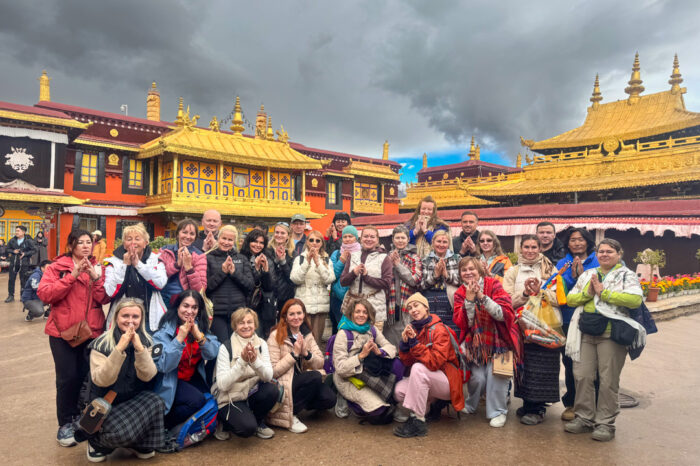
A transformative 15-day spiritual journey from Lhasa to sacred Mount Kailash, featuring a traditional three-day kora, ancient monasteries, and the mysterious Garuda Valley.

Mount Kailash and Lake Manasarovar Trek
Mount Kailash, known as the Precious Jewel of Snows in Tibetan, is considered by Buddhists to be the abode of the deity Chakrasamvara. It is said that if one performs 108 circumambulations, one will reach …
Sacred Mt. Kailash
Mt. Kailash, known as the "Precious Jewel of Snows" in Tibetan, is revered by Buddhists as the dwelling place of the deity Chakrasamvara. It is believed that completing 108 circumambulations around the mountain leads to …
We are recommended by
We are committed to providing authentic, high quality, environmentally sustainable travel services. Join us and experience once in a lifetime holiday.
Recent Trips
.jpg "amdo monlam festival tour")