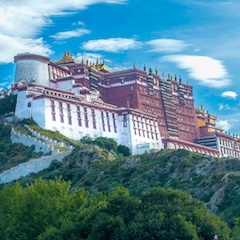
Mount Kailash and Lake Manasarovar Trek
Mount Kailash, known as the Precious Jewel of Snows in Tibetan, is considered by Buddhists to be the abode of the deity Chakrasamvara. It is said that if one performs 108 circumambulations, one will reach enlightenment.
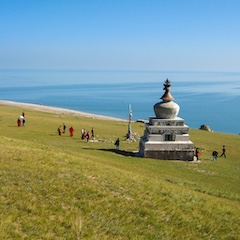
Below the Sacred Mount Kailash, there are two majestic lakes: Lake Manasarovar and Lake Rakshas Tal. Lake Manasarovar, also known as Mapham Yumtso Lake in Tibet, means “lake conceived from the Mind of God.” This turquoise, brilliant, and serene lake is considered one of the holiest and most powerful lakes in Tibet and India. At an altitude of 4,570 meters, it is also one of the highest bodies of pure water on the surface of the earth. Mt. Kailash is reflected on the surface of this holy lake for much of the year.
Highlights
- Lhasa, the cradle of Tibetan civilization
- Yamdork Yumtso Lake, Peikutso Lake
- 5 day Holy lakes Manasarovar Kora
- 3 day Mt. Kailash trek
- Qiu monastery hotspring, Tirthapuri or Zhadaburi hotspring
Details
- 17-day trip begins in Lhasa and ends in Kyirong border
- 19-day trip begins and ends in Lhasa
- 18 nights in hotels and guesthouses for ending in Lhasa
- 16 nights in hotels & guesthouses for exiting at Nepal border
- Altitude from 3600-5600m
Itinerary:
Day 1: Arrive in Lhasa (3658 m)
Welcome to Lhasa! Transfer to your hotel and get settled. If you arrive early, you can walk around the famous Barkhor Street on your own.
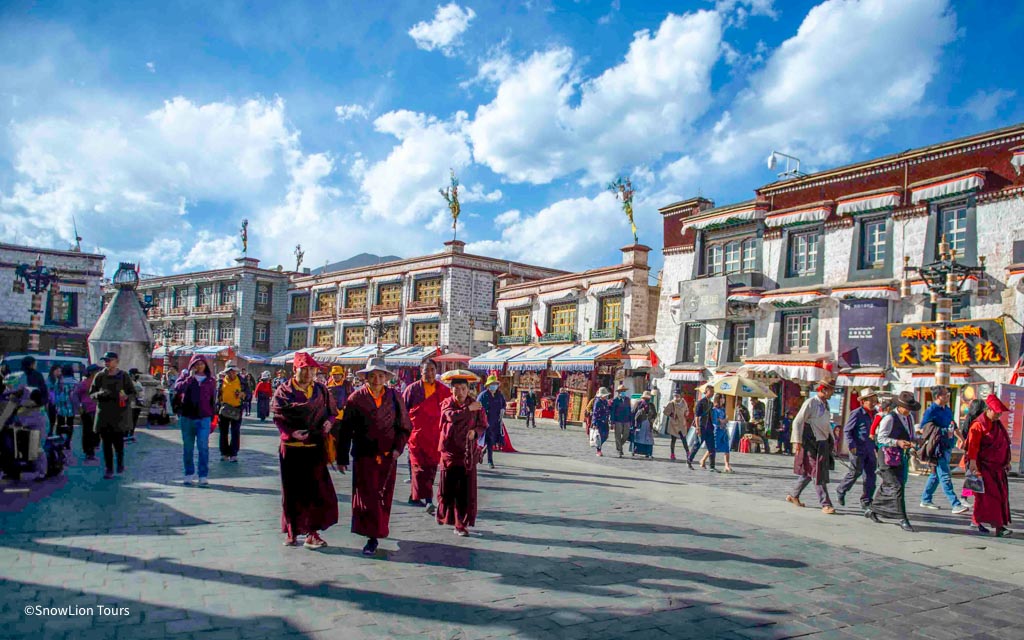
Walking around Jokhang Temple in Lhasa, Tibet
Day 2: Lhasa sightseeing: Drepung Monastery, Nechung Temple, and Sera Monastery
Visit Drepung Monastery in the morning, one of the three most famous monasteries in Lhasa. Drepung is located just outside Lhasa on Gambo Utse Mountain. Once home to as many as 10,000 monks, the enormous monastic complex is the site of many prayer halls, monks’ residences, and temples. Just below the monastery is the Nechung Temple, the former home of the state oracle. Afterwards, visit Sera Monastery, where you can watch monks debating in the courtyard. If you enjoy hiking, walk the hour-long circumambulation path around the monastery complex.
‘Debating is a common way of study by monks in some Tibetan schools. The monks’ debate sessions take place around 3 pm in Sera Monastery from Monday to Saturday. The subject of debating can vary, but the main focus is always on finding ultimate truth or reality. This method of studying has been used for centuries in Tibet and India.’
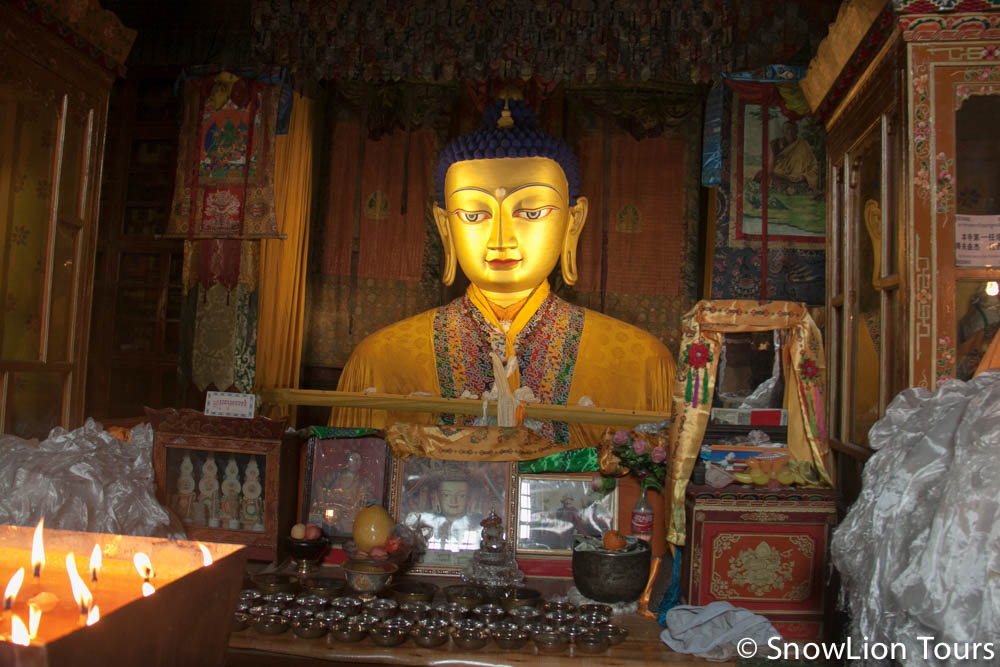
Buddha Statue in Drepung Monastery
Day 3: Lhasa sightseeing: Potala Palace, Rock Paintings of Medicine Hill, Jokhang Temple, and Barkhor Street
In the morning, visit the Potala Palace, the winter palace for Dalai Lamas as well as the greatest monumental structure in all of Tibet. Afterwards, we will visit the rock paintings nearby Potala Palace. Then we will walk to Barkhor Street and visit the Jokhang Temple, located in Barkhor Square in Lhasa. The Jokhang Temple is dedicated to the statue of Jowo Shakyamuni and is the holiest temple in all of Tibet. Pilgrims from all over flock to this temple to catch a glimpse of the Jowo Buddha, a statue that is said to have been blessed by the Buddha himself. After exiting the temple, you will be on Barkhor Street, a famous shopping street filled with goods and souvenirs from Tibet, Nepal, and India. When you follow local pilgrims, make sure to make the kora or circumambulation around Jokhang Temple clockwise.
Day 4: Lhasa – Yarlung Tsangpo River – Yamdrok Lake – Korala Glacier – Gyantse – Shigatse (3836m), 360km, 7 hours
Begin your adventure in the Himalayas, driving to Gyantse. Along the way, cross over the Kamba-La (4794m) and Karo-La passes (5010m), which boast spectacular views. After Kamba-La, arrive at Yamdrok Lake, a holy turquoise-colored lake with stunning scenery. Afterwards, visit the Pelkor Chode Kumbum and Gyantse Monastery, followed by a two-hour drive to Shigatse. Here, see the giant Buddha in the famous Tashilhunpo Monastery. Time allowing, join pilgrims in walking the long circumambulation path around the monastery, or explore the city streets. Spend the night in Shigatse.
Day 5: Shigatse – Langtso Lake – Saga (4640m), 450km, 9 hours
Drive up to high mountain passes with a great view of the Himalayas. You’ll drive through the countryside and grasslands, where you can see small lakes and nomads camping with their yaks and sheep. After about 180km, you will reach the beautiful alpine Langtso Lake at an elevation of 4300m. There are yaks and sheep scattered around the lakeside. This is a great place to have a short break and stretch your legs during the long drive. In the late afternoon, cross over the Brahmaputra River on the way to a typical Chinese and Tibetan town. Spend the night in Saga.
Day 6: Saga – Paryang – Darchen (4575m), 450km, 9 hours
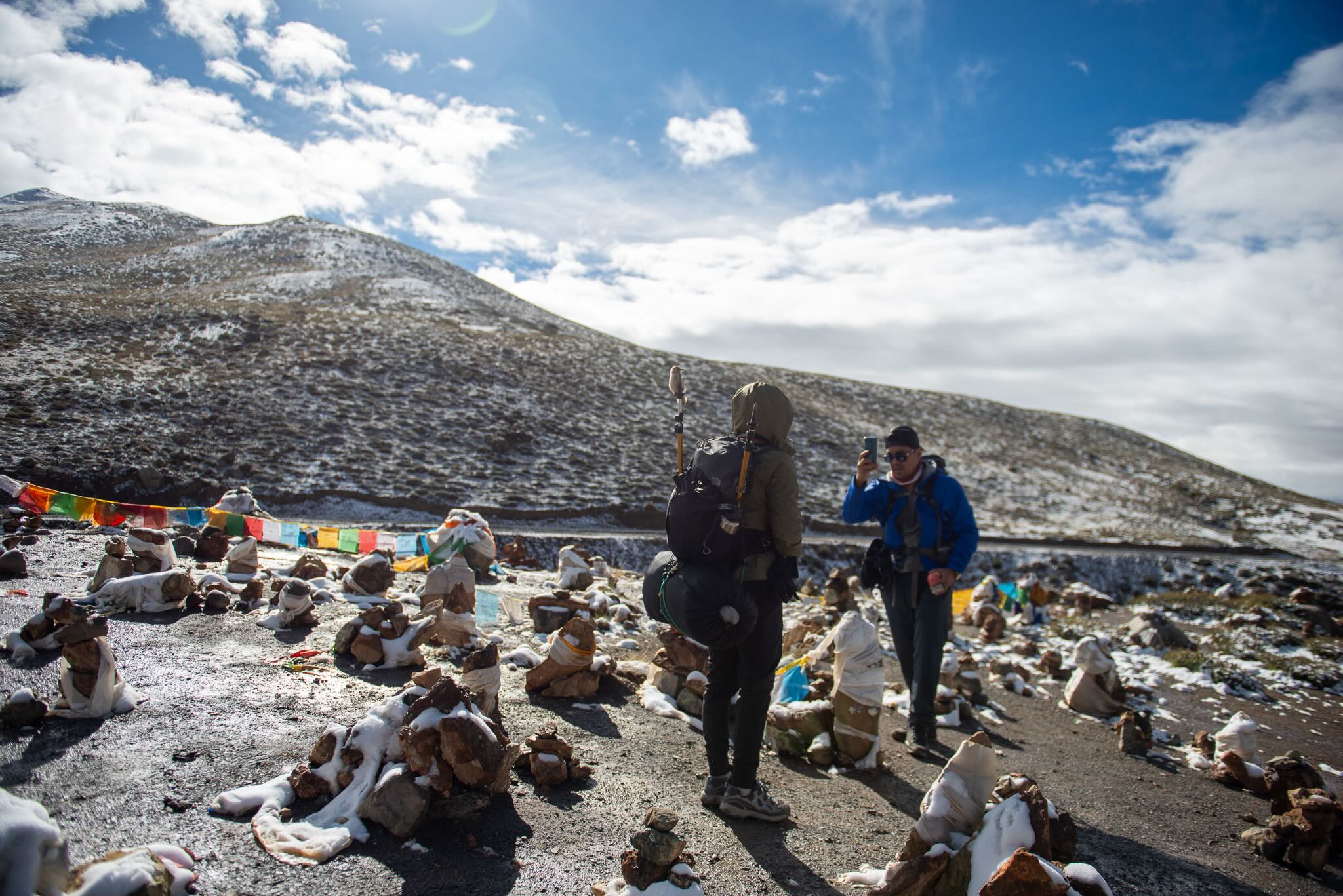
Drive through a wide valley along a scenic river and look out on the grazing lands of yaks and sheep. Towards the south, you can see sand dunes, rocky mountains, and snow-capped peaks. Depending on the season, nomads and other mobile shopkeepers will be attired in beautiful traditional costumes. Join them for a cup of hot tea in their home. Continue driving west. In the late afternoon, you will catch your first sight of the Holy Mt. Kailash. Spend the night in a small town near Mt. Kailash.
Day 7: Darchen – Tirthapuri / Zhadaburi (4310m) – Darchen (4575m), 150km, 4 hours
In the morning, drive to Tirthapuri. Before reaching Tirthapuri, a steamy hot spring flows down from white rocks below the monastery. This is the famous Tirthapuri Hot Spring. Then drive several kilometers inside the valley until the monastery complex comes into view. Tirthapuri Monastery has a special connection with Guru Rinpoche, and the first chapel in the main temple contains a footprint of Guru Rinpoche. This monastery is also known as the gateway to Mt. Kailash. Many locals visit this monastery before the Mt. Kailash Kora. The region is rich in gold and other minerals, hot springs, and hundreds of wild creatures. In the afternoon, drive back to Darchen to prepare for the 3-day trek around Mt. Kailash. Overnight at Darchen.
Day 8: Kailash Trekking Kora Day 1
Walk along beautiful rocky cliffs and take pictures of breathtaking waterfalls. Take deep breaths of fresh air. From time to time, the face of Mt. Kailash will appear. Be prepared for some difficult hiking.
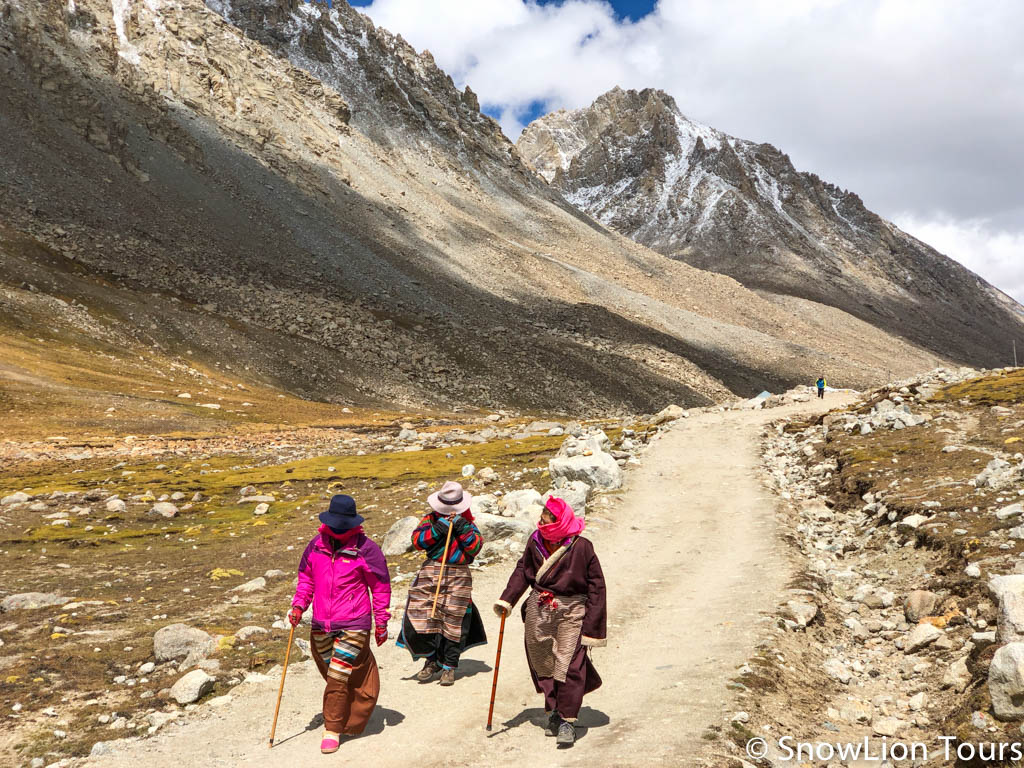
Tibet trekking
Day 9: Kailash Trekking Kora Day 2
Hike across a valley up to the Dolma-La Pass. At the top, make an offering, take a break (or meditate), and forget all your cares and worries. Afterwards, begin descending. By the late afternoon, arrive at Zuthal Puk, the cave of miracles where Milarepa once stayed.
Day 10: Kailash Trekking Kora Day 3, then drive to Mansarovar (4500m), rest in Qiu Hot Springs
Start the day by following one of the clearest rivers you have ever seen. The trail is flat and much greener. At the end of the valley before turning right, a stunning view of the snow-capped Nemo Nani (altitude 7728m) will appear before you. After finishing your circuit of Mt. Kailash, you will drive to Lake Mansarovar and can rest and take a bath in the Qiu Monastery hot spring. Rest at the lake.
Day 11: Manasarovar Kora Day 1: (28km / 8 hours)
The first trekking day starts from Barka to Hor Township (4560m), covering 28km. Hor is a town with a collection of mud-walled houses and assorted compounds, located slightly inland from the northeastern corner of Mapam Yumtso. There are some guesthouses and shops where you can refill some of your supplies. Spend the night in guesthouses (very basic).
Day 12: Manasarovar Kora Day 2: (10.5km / 3 hours)
The trekking continues to Seralung Monastery, covering 10.5km. For the first few kilometers, you will stay close to the shoreline.
Day 13: Manasarovar Kora Day 3: (23km / 7 hours)
Today the trail cuts across a sandy headland. After a bridge crosses the Trak Tsangpo River, Trugo Gon comes into view. Eventually, the track passes the ruins of Nyego Monastery. From here, Trugo Gon is simply a one-hour walk away. Trugo Gon is the most active monastery around the lake. Originally Drukpa Kagyu, it has long been affiliated with Shepeling at Purang. Stay in a guesthouse (very basic).
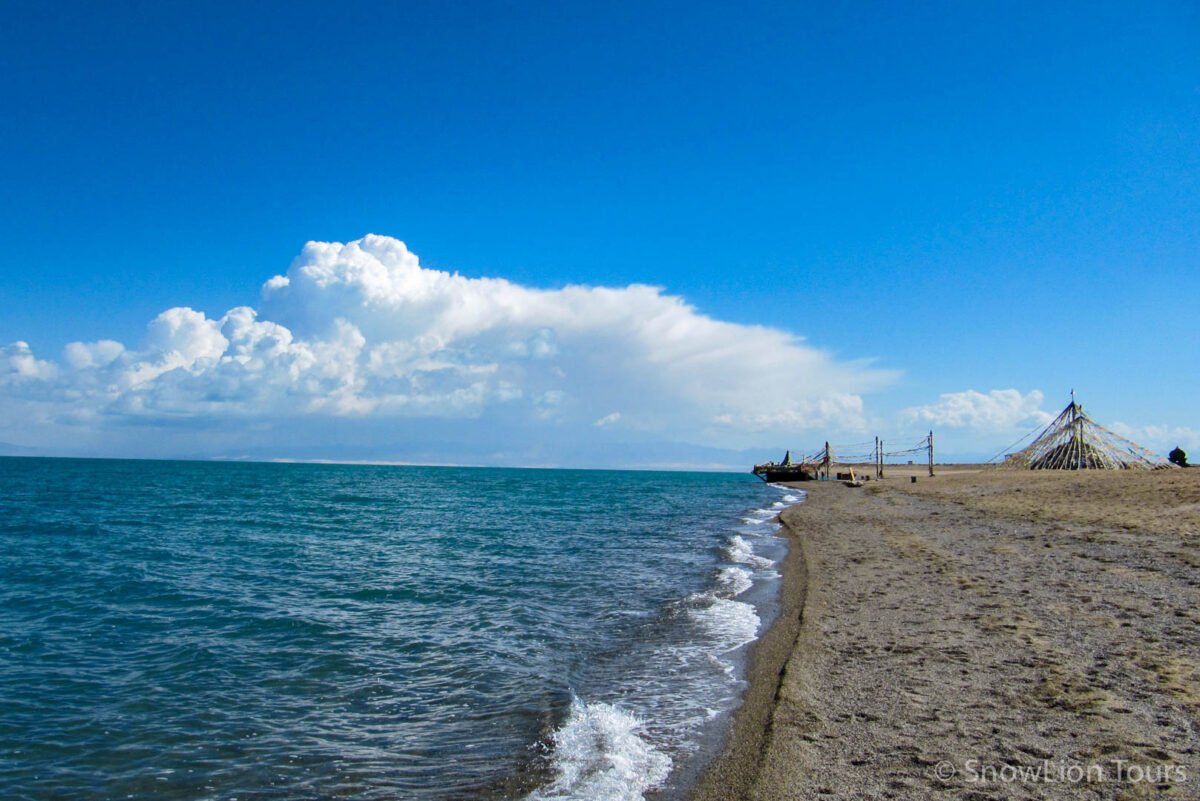
Day 14: Manasarovar Kora Day 4: (15km / 5 hours)
From Trugo Gon, follow the shoreline for most of the day. After turning north, the western shoreline becomes a low cliff face. Some four or five hours from Trugo Gon, you will observe caves with blackened ceilings that were once inhabited. Above them is the rebuilt Geluk Monastery of Gotsuk Gon. Spend the night in a guesthouse (very basic).
Day 15: Manasarovar Kora Day 5: (12km / 4 hours) – Saga
Continue following the shoreline as the trail turns left, pointing almost directly to Mt. Kailash in the distance. The trail then swings north towards Tseti guesthouse. It is said that Mahatma Gandhi’s ashes were brought here and cast into the lake’s waters. Today involves just four hours of trekking. After completing the kora, start the journey back to Lhasa. Overnight in Saga.
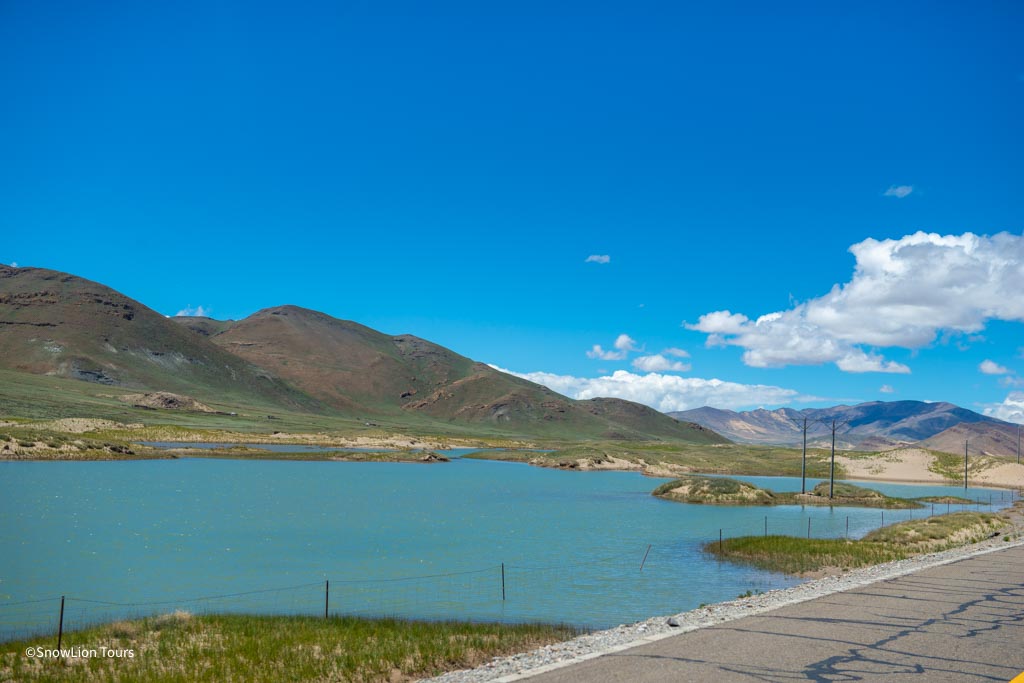
A lake at the road side on the way to Mount Kailash.
Day 16: Saga – Kyirong (Nepal border), 2800m
Continue driving in the Himalayas. If the weather permits, you will have a great view of Mt. Shishapangma and other snow peaks. After ascending to Gongtang La Pass, which is the last highest point of this trip with an elevation of 5300m, the zig-zag road will lead us down to the valley. The altitude decreases dramatically as you descend into the valley, and the geography changes from the dry and arid Tibetan Plateau to green forests. Cross the China-Nepal border at Kyirong Port.
Tour map
-
DepartureKathmandu
-
Departure TimePlease arrive by 8:20 AM for a prompt departure at 8:30 AM
-
Return TimeApproximately 8:30 PM
-
IncludedEntrance ticketsLocal transportationAccomodationTibetan English speaking guideTibet Travel PermitsTibet/China Group Visa
-
Not IncludedFoodTips for guide and driverTravel InsurancePlane or train tickets
Recent Posts
- Shoton Festival Begins in Lhasa!
 August 23, 2025
 - Tour Price in Tibet
 August 23, 2025
 - Qinghai Shaman Festival in Rebkong Concludes Successfully
 August 21, 2025

.jpg "amdo monlam festival tour")