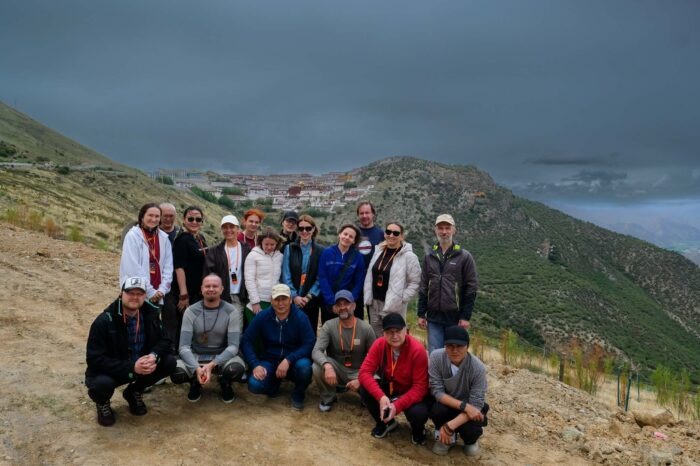
Samye Monastery is Tibet’s first complete Buddhist monastery and one of the most important sacred sites in the history of Tibetan Buddhism.
Samye Monastery is one of the most important religious and historical sites in Tibet. Located near the north bank of the Yarlung Tsangpo River, it is traditionally known as the first complete Buddhist monastery in Tibet, with monks, temples, ritual practice, translation work, and monastic learning all brought together in one place. For this reason, Samye is not simply another monastery; it is one of the birthplaces of Tibetan Buddhism as a living institution.
The monastery was founded in the 8th century during the reign of King Trisong Detsen, one of Tibet’s great religious kings. According to Tibetan tradition, the Indian master Shantarakshita helped introduce the monastic and philosophical foundation, while Guru Rinpoche, also known as Padmasambhava, helped overcome obstacles and establish Buddhism more firmly in Tibet. This combination of royal support, Indian Buddhist scholarship, and tantric spiritual power gives Samye a unique place in Tibetan memory.
Samye is especially significant because it marks the point where Buddhism moved from royal patronage and scattered practice into an organized Tibetan religious institution. It became a center for translation, debate, ritual, and monastic training. Many important Buddhist texts were translated from Sanskrit into Tibetan in this period, helping create the foundation for Tibet’s later Buddhist culture.
Samye is also closely connected with the early Nyingma tradition. Guru Rinpoche’s role in the monastery’s founding made Samye one of the most sacred places for followers of the Nyingma lineage, although the site is respected by all Tibetan Buddhist traditions. Pilgrims come here not only to see an ancient monastery, but to connect with the moment when the Dharma became deeply rooted on the Tibetan Plateau.
The monastery is also remembered for the famous Samye Debate, traditionally associated with discussions about Indian and Chinese Buddhist approaches to practice. The historical details are complex, but the memory of the debate shows Samye’s importance as a place where Tibet shaped its own Buddhist identity.
One of the most distinctive features of Samye is its mandala-style layout. The central temple represents Mount Meru, the sacred mountain at the center of the Buddhist universe, while surrounding chapels and structures symbolize continents and cosmic directions. This makes Samye more than a collection of buildings: the entire monastery is designed as a sacred map of the Buddhist cosmos.
For travelers, this layout gives Samye a special atmosphere. Walking around the monastery is not only sightseeing; it is also a kind of movement through Buddhist cosmology. The central Utse Temple, surrounding chapels, walls, and stupas create a complete ritual landscape. This is one reason Samye feels different from many later monasteries in Tibet.
The central temple is the main highlight, with chapels, statues, murals, and religious images connected with the early spread of Buddhism in Tibet. Visitors should also pay attention to the monastery layout, the outer walls, the stupas, and the wider landscape. The sand dunes near Samye and the nearby Chimphu Meditation Caves add to the feeling that this whole area is a sacred region rather than a single isolated monument.
Samye is often visited together with Yumbulakang Palace, Trandruk Monastery, and Chimphu. Together, these places tell the story of early Tibetan kingship, the first great Buddhist foundations, and the retreat traditions that shaped Tibetan spiritual life.
For travelers interested in Tibetan culture, Samye is one of the most rewarding places outside Lhasa. It helps explain how Buddhism became Tibetan, how Indian teachers influenced Tibetan history, and how sacred architecture can express an entire religious worldview. It is also a peaceful place to slow down, watch pilgrims, and feel the continuity of centuries of devotion.
Allow enough time to explore the monastery slowly. A guide is highly recommended because the significance of Samye is found not only in what you see, but in the stories behind the buildings, chapels, and layout. If you have time, include Chimphu Meditation Caves on the same journey, as Chimphu adds a powerful retreat and pilgrimage dimension to the Samye experience.
Explore more! Join to get updates on Tibet tours and departures.
A classic trek from Ganden Monastery to Samye, crossing high passes, valleys, villages, and sacred Buddhist sites in central Tibet.
Starting in Lhasa, discover the famous Potala Palace, watch the monks debate at Sera Monastery, and sip tea on a rooftop overlooking the bustling Barkhor market square. Follow the Nyang River out of Lhasa to …
In the sacred city of Lhasa, visit the grand Potala Palace, the holy Jokhang Temple, and the colorful Barkhor Square. Watch monks debate at Sera Monastery and join pilgrims in exploring the temples and prayer …