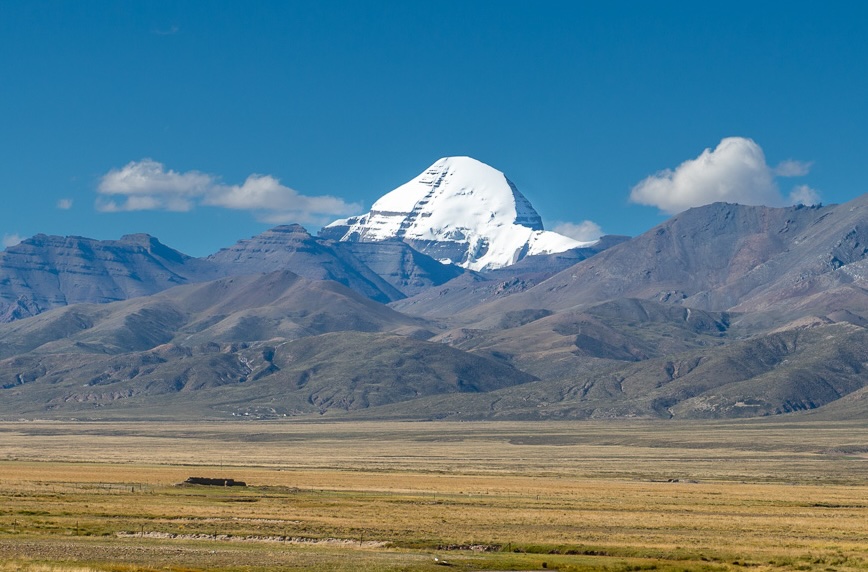
Mount Kailash, known in Tibetan as Gang Rinpoche, is one of the most sacred mountains in Asia. Rising to about 6,638 meters in Burang County of Ngari, western Tibet, it stands north of Lake Manasarovar and Lake Rakshastal in a high, dry landscape where the Himalaya, Gangdise range, ancient trade routes and living pilgrimage traditions meet.
For travelers, Mount Kailash is not just a mountain view. It is a journey into Tibet’s far west, a high-altitude pilgrimage circuit, and a place where Buddhism, Hinduism, Jainism and Bon have all placed deep spiritual meaning. This Mount Kailash guide explains the history, religious importance, kora route, permits, altitude, best travel season and practical planning points for visiting respectfully.
Where Is Mount Kailash?
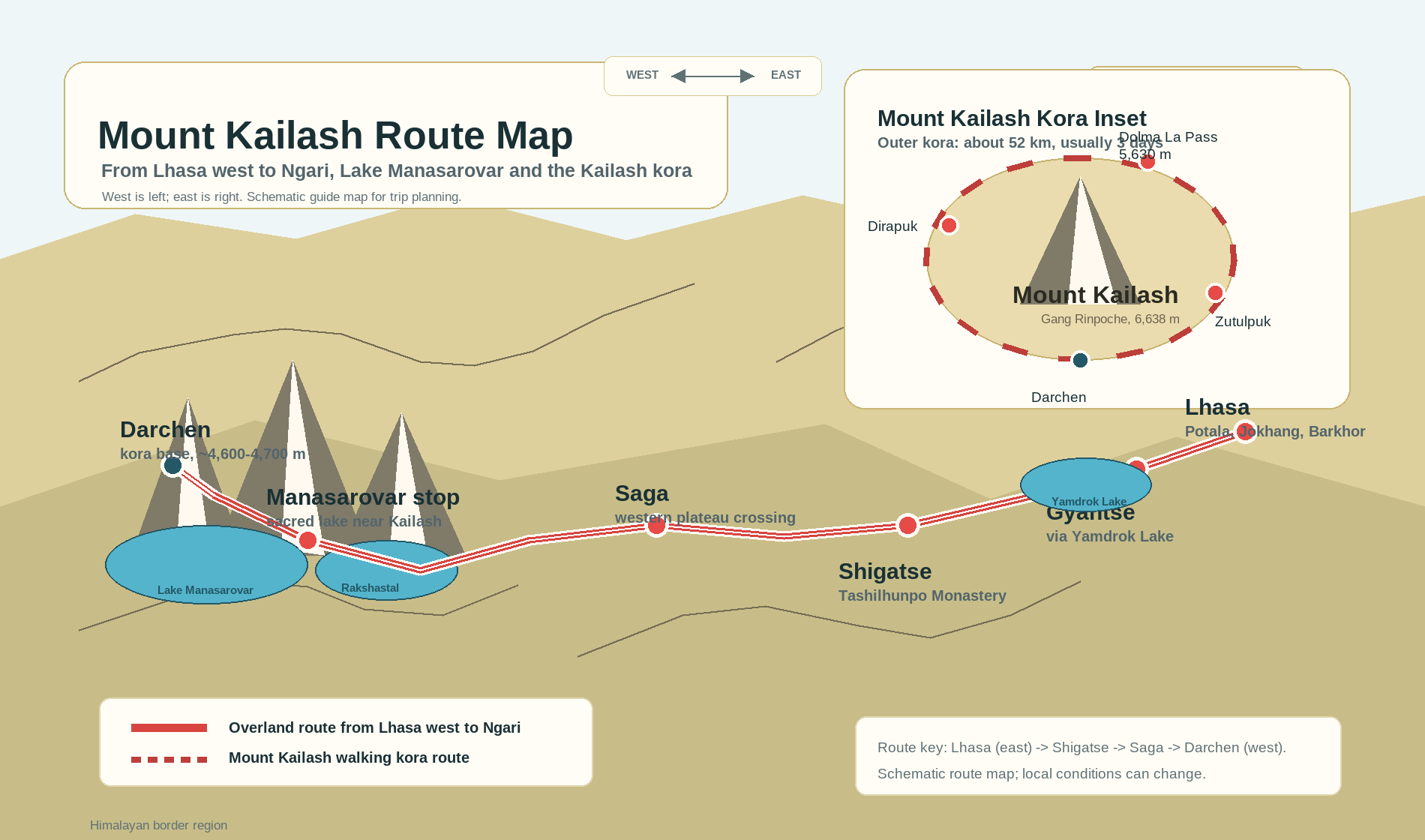
Mount Kailash is located in far western Tibet, in Burang County of Ngari Prefecture, near the borders of Nepal and India. The mountain belongs to the sacred landscape around Lake Manasarovar and Lake Rakshastal. UNESCO’s tentative listing for the Sacred Mountains and Lakes area describes this region as a compact landscape of two sacred mountains and two lakes, with Mount Kailash, or Gang Rinpoche, as the best-known peak.
The usual traveler base for the Kailash kora is Darchen, a small service town at roughly 4,600 to 4,700 meters. From Lhasa, the overland journey to Darchen normally takes several days, passing through Shigatse, Saga and the wide plateau country of western Tibet. Many itineraries also include Lake Manasarovar, Guge Kingdom or other Ngari destinations.
Why Mount Kailash Is So Sacred
Mount Kailash has a rare place in world religion because several major traditions revere the same mountain, even though they explain its meaning in different ways. That shared reverence is one reason the peak itself is not climbed. The respectful journey is around the mountain, not to the summit.
Mount Kailash in Tibetan Buddhism
For Tibetan Buddhists, Mount Kailash is closely associated with the tantric deity Demchok, also known as Chakrasamvara. Pilgrims walk the kora to purify negative karma, generate merit and connect with a landscape linked to great meditation masters. The area is especially important around Saga Dawa, the sacred fourth month of the Tibetan calendar, when many pilgrims gather to honor the birth, enlightenment and parinirvana of Buddha Shakyamuni.
Tibetan Buddhist pilgrims usually walk clockwise around Mount Kailash. Many prostrate along sections of the route, touching the earth again and again as an act of devotion. Travelers should give pilgrims space, avoid stepping over prayer objects or prostration boards, and ask before taking close photographs.
Mount Kailash in Hinduism
In Hindu traditions, Mount Kailash is honored as the abode of Lord Shiva and Parvati. The mountain is often imagined as a cosmic axis, a point connecting heaven and earth. For many Hindu pilgrims, the journey to Kailash and Lake Manasarovar is one of the great yatras of a lifetime.
Lake Manasarovar, south of Mount Kailash, adds another layer of holiness. Pilgrims may pray beside the lake, make offerings, or perform ritual bathing when conditions and local rules allow. Travelers should remember that this is a living sacred place, not only a scenic lake stop.
Mount Kailash in Jainism
For Jains, the Kailash region is associated with Ashtapada and the first Tirthankara, Rishabhanatha. Not all historical identifications are simple, but the religious connection has made the region an important part of Jain sacred geography and pilgrimage imagination.
Mount Kailash in Bon
Bon, Tibet’s ancient spiritual tradition, also regards Mount Kailash as deeply sacred. Bon pilgrims traditionally walk the kora counterclockwise, opposite the direction used by most Tibetan Buddhist and Hindu pilgrims. This difference is one of the clearest visible signs of the mountain’s layered religious life.
Why Mount Kailash Has Not Been Climbed
Mount Kailash is not treated like a mountaineering objective. Although it is lower than many Himalayan expedition peaks, it remains unclimbed because of its sacred status. For pilgrims, climbing the mountain would be disrespectful. The meaningful act is circumambulation, or kora, around the mountain.
There is no need to seek a summit story here. Kailash has power precisely because it is approached with restraint. The mountain is viewed, walked around, prayed toward and remembered, not conquered.
The Mount Kailash Kora
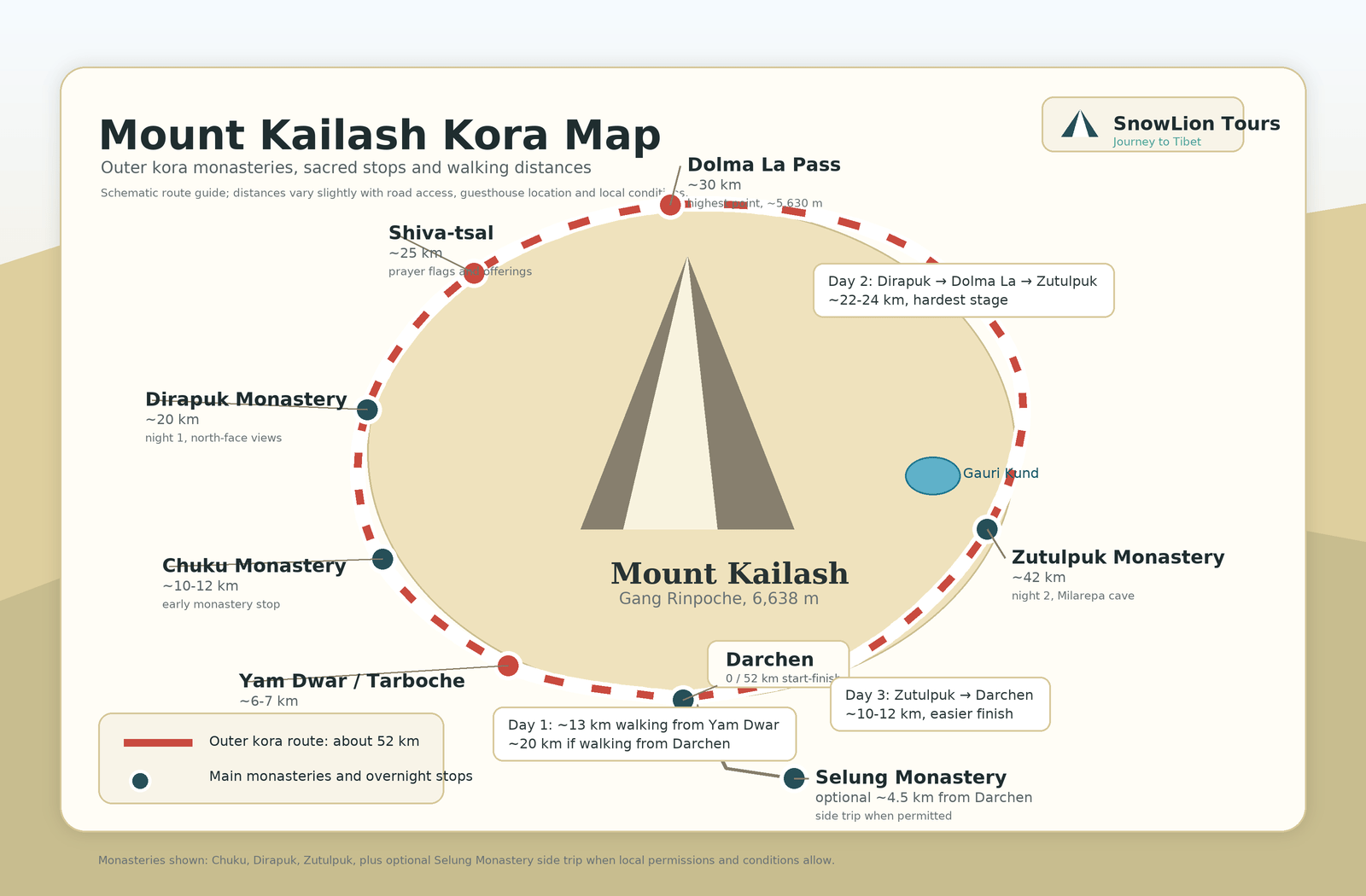
The outer Mount Kailash kora is about 52 kilometers and is usually completed in three days. Distances vary slightly depending on the guesthouse location, local route conditions and where vehicles are allowed to stop. The highest point is Dolma La Pass, generally given at about 5,630 meters.
The kora is physically demanding because almost the entire route is above 4,600 meters. Even strong walkers can feel slow at this altitude. The trail is not technically difficult in normal conditions, but altitude, weather, wind, cold and long walking days make it serious.
Day 1: Darchen to Dirapuk
The first day normally begins from Darchen and follows the valley northward toward Dirapuk Monastery. This stage is often around 13 kilometers. The walking is steady rather than steep, and the north face of Mount Kailash becomes one of the great rewards of the day. Dirapuk is above 5,000 meters, so even sleeping here can feel challenging for travelers who have not acclimatized well.
Day 2: Dirapuk to Zutulpuk via Dolma La Pass
The second day is the hardest and most important stage of the kora. The route climbs from Dirapuk to Dolma La Pass, the highest point of the circuit, before descending past sacred sites and continuing toward Zutulpuk. This day can be 22 to 24 kilometers depending on exact start and finish points.
The ascent to Dolma La is slow and exposed. Snow, ice, wind and sudden weather changes are possible even outside winter. Many pilgrims pause at the pass for prayers and offerings. After the pass, the descent is steep in places and should be taken carefully, especially if the trail is icy or crowded.
Day 3: Zutulpuk to Darchen
The final day is usually easier, around 11 to 14 kilometers, following the valley back toward Darchen. The landscape opens gradually, and many travelers feel a strong emotional release as the circuit comes to an end. Finishing the kora does not mean rushing away; it is worth allowing time to rest, drink water, and process the experience.
Altitude and Difficulty
A Mount Kailash journey is a high-altitude trip from beginning to end. Lhasa is already about 3,650 meters, Saga is higher, Darchen is around 4,600 to 4,700 meters, and the kora crosses Dolma La at about 5,630 meters. The base of the mountain is above 15,000 feet, and U.S. travel health guidance for Kailash pilgrims highlights the risk of acute mountain sickness at these elevations.
The best preparation is a gradual itinerary. Do not fly into Lhasa and rush west immediately. A responsible route gives time in Lhasa and central Tibet before crossing into Ngari. This helps the body adapt and also makes the journey richer, with visits to major monasteries and cultural sites before the remote western plateau.
Travelers with heart, lung, blood-pressure or serious medical conditions should speak with a doctor before planning the kora. Even healthy travelers should walk slowly, hydrate well, eat enough, avoid alcohol early in the trip, and tell the guide immediately if headaches, nausea, dizziness, unusual breathlessness or confusion appear.
Best Time to Visit Mount Kailash
The main Mount Kailash travel season is from May to early October. The best balance of weather, road access and walking conditions is usually May, June, September and early October.
- May and June: Good pilgrimage season, often with strong spiritual atmosphere around Saga Dawa. Nights can still be cold, and snow may remain near Dolma La.
- July and August: Warmer, but also the wetter summer period. Roads and trails can be affected by rain, mud or clouded mountain views.
- September and early October: Often clear and beautiful, with colder nights and generally strong visibility.
- Late October to April: Very cold, with greater risk of snow, icy trails and limited services. This period is not ideal for most travelers.
Weather in western Tibet can change quickly. A clear morning does not guarantee a clear pass. Good itineraries keep some flexibility and avoid pushing the kora in unsafe conditions.
Permits for Mount Kailash
Foreign travelers cannot travel independently in the Tibet Autonomous Region, and Mount Kailash requires more paperwork than a short Lhasa visit. In general, international travelers need a Chinese visa or China/Tibet group visa if entering from Nepal, a Tibet Travel Permit, an Aliens’ Travel Permit, and additional permits for Ngari and border areas. These permits must be arranged through a licensed travel agency as part of an organized tour.
Permit rules can change, especially for border regions and pilgrimage seasons, so travelers should not rely on old forum posts or outdated guidebooks. See SnowLion Tours’ Tibet Travel Permits page for broader permit background, and confirm the latest Kailash requirements before booking flights.
How Many Days Do You Need?
A careful Kailash itinerary normally needs at least 13 to 18 days if starting and ending in Lhasa, depending on whether the trip includes Everest, Guge Kingdom, Lake Manasarovar, or a Nepal border crossing. Shorter routes may look attractive on paper, but fast itineraries can increase altitude risk and reduce the chance to understand the cultural journey.
A classic route might include Lhasa, Yamdrok Lake, Gyantse, Shigatse, Saga, Lake Manasarovar, Darchen, the three-day Kailash kora, and the return journey across western and central Tibet. Travelers who want deeper history may add Zanda, Tholing Monastery and the ruins of Guge Kingdom.
Lake Manasarovar and Nearby Sacred Sites
Lake Manasarovar is one of the most important sacred lakes in Asia and is often paired with Mount Kailash in pilgrimage itineraries. The lake sits south of Kailash, with wide views across the plateau toward Gurla Mandhata and the surrounding mountains.
Nearby places that can add depth to a Kailash journey include:
- Lake Manasarovar: A sacred lake for prayer, reflection and wide plateau views.
- Rakshastal: A dramatic salt lake west of Manasarovar, often seen on the approach to Darchen.
- Tirthapuri: A sacred hot spring and pilgrimage site associated with Guru Rinpoche.
- Guge Kingdom: The ruins of an important western Tibetan kingdom in Zanda County.
- Tholing Monastery: A major monastery connected with the second diffusion of Buddhism in Tibet.
How to Travel Respectfully
Mount Kailash is a sacred landscape first and a travel destination second. Respectful behavior matters for pilgrims, local communities and the long-term protection of the region.
- Walk slowly and give pilgrims space, especially those doing full-body prostrations.
- Ask before photographing people, ritual objects, prayer ceremonies or monastery interiors.
- Do not remove stones, prayer flags or offerings from sacred places.
- Pack out rubbish and avoid single-use plastic where possible.
- Dress warmly but modestly, especially near monasteries and pilgrimage sites.
- Listen to your guide if weather, road or permit conditions require a change.
What to Pack for the Kailash Kora
Pack for cold, wind, high sun and simple accommodation. Even in summer, nights near the kora can be freezing. Useful items include layered clothing, a warm down jacket, rain shell, gloves, warm hat, sun hat, sunglasses, sunscreen, lip balm, trekking poles, headlamp, personal medicines, water bottle, snacks and a good sleeping bag if your itinerary uses basic guesthouses.
Footwear should be broken in before the trip. New boots on Dolma La are a bad experiment. For broader preparation, SnowLion’s Tibet Trekking Guide is useful for high-altitude walking in Tibet.
Is Mount Kailash Right for You?
Mount Kailash is best for travelers who want more than a sightseeing trip. The road is long, the altitude is real, accommodation is simple in remote areas, and the kora requires patience. But for those who are prepared, it can be one of the most meaningful journeys in Tibet: a meeting of landscape, faith, endurance and quiet attention.
If you are deciding between a cultural Tibet tour and a Kailash pilgrimage, be honest about fitness, time and motivation. A good Kailash journey should not feel rushed. It should give enough space for Lhasa’s sacred sites, the plateau road west, Lake Manasarovar and the kora itself.
Frequently Asked Questions
How long is the Mount Kailash kora?
The outer kora is about 52 kilometers and is usually completed in three days. Some Tibetan pilgrims complete it faster, but travelers should not rush because of the altitude.
What is the highest point on the Kailash kora?
The highest point is Dolma La Pass, usually given at about 5,630 meters. This is the hardest day of the circuit and requires slow pacing and good acclimatization.
Can foreign travelers visit Mount Kailash independently?
No. Foreign travelers must join an organized tour with a licensed agency and travel with the required Tibet and Ngari permits.
Do I need to be Buddhist or Hindu to do the kora?
No. Many travelers walk the kora for cultural, spiritual or personal reasons. What matters is respect for the pilgrims and sacred landscape.
Can you climb Mount Kailash?
No. Mount Kailash is not climbed because of its sacred status. The accepted pilgrimage is the kora around the mountain.
When is the best month for Mount Kailash?
May, June, September and early October are generally the best months. Saga Dawa can be spiritually powerful but also busier, while July and August may bring more rain and cloud.
Is Lake Manasarovar included with Kailash tours?
Most good Kailash itineraries include Lake Manasarovar because it is close to Mount Kailash and is itself one of the most sacred places in western Tibet.
Planning a Mount Kailash Journey with SnowLion Tours
SnowLion Tours arranges private and group journeys to western Tibet, including Mount Kailash, Lake Manasarovar, Guge Kingdom and other Ngari destinations. Our team can help plan the right pace, permits, route and acclimatization schedule for your time, interests and fitness level.
For tour options, see our Mount Kailash tours or contact us to design a private Kailash and western Tibet itinerary.
Mount Kailash Tours We Offer
If you are ready to turn this guide into a real journey, these SnowLion Tours itineraries include Mount Kailash, Lake Manasarovar and the three-day kora in different travel styles.
- Everest and Kailash Yatra – a longer western Tibet journey combining Lhasa, Everest Base Camp, Mount Kailash and the Kailash kora.
- Sacred Mt. Kailash – a classic Lhasa to Mount Kailash pilgrimage with Lake Manasarovar and the full kora.
- Mount Kailash and Guge Kingdom – a deeper western Tibet journey combining the Kailash kora with Guge Kingdom and Ngari history.
- Full Moon Mt. Kailash Kora – a cultural and spiritual Kailash journey timed around the full moon.


.jpg "amdo monlam festival tour")