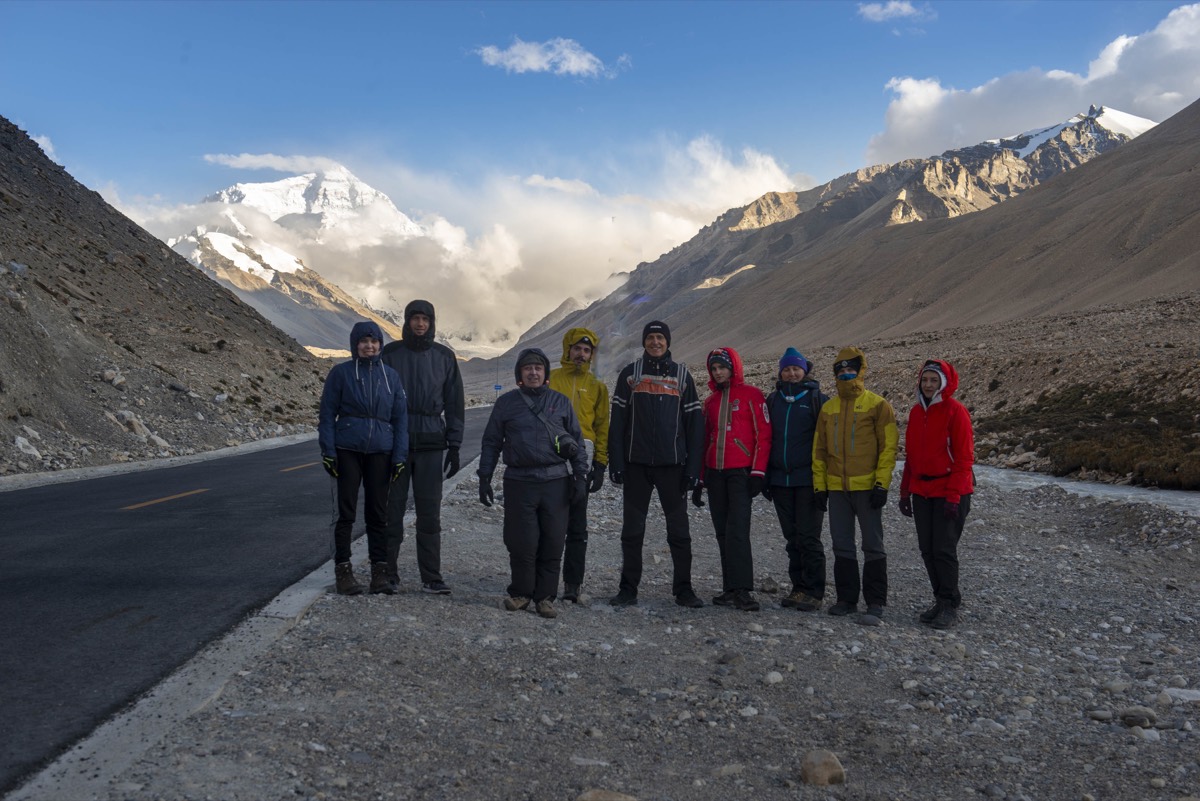
Tibet Everest Base Camp is one of the most powerful journeys on the Tibetan Plateau. From Lhasa, the road crosses sacred lakes, old fortress towns, high passes, farming valleys and the wide Himalayan frontier before arriving near Rongbuk Monastery, where the north face of Mount Everest rises directly above the valley.
This guide is for travelers planning the Tibet side of Everest, often called Qomolangma in Tibetan. It explains what visitors can realistically see, how the overland route works, which permits are needed, how high the journey goes, when to travel and how to prepare for the altitude. It is written for sightseeing travelers, photographers, cultural travelers and overland adventurers, not for mountaineering expeditions.
What Is Tibet Everest Base Camp?
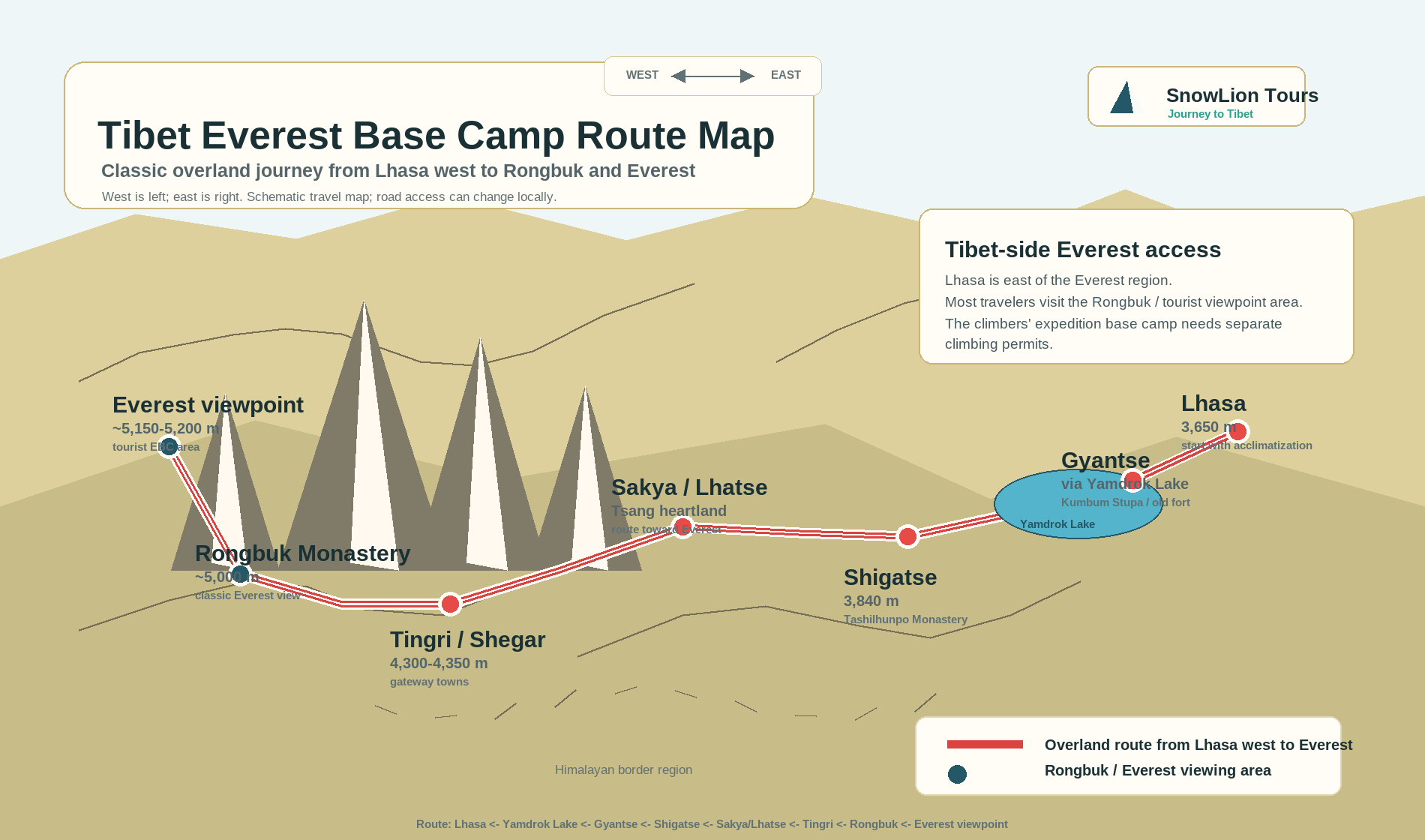
Everest Base Camp in Tibet refers to the north-side Everest viewing area in Tingri County, Shigatse Prefecture, close to Rongbuk Monastery and the Qomolangma National Nature Reserve. The mountain itself stands on the border between Tibet and Nepal and has an official height of 8,848.86 meters.
For ordinary travelers, the important point is this: the Tibet Everest experience is now centered around the Rongbuk Monastery and tourist viewing area. Access to the climbers’ expedition base camp and the protected core area is restricted and requires separate mountaineering permission. Policies can change locally, so a responsible Tibet travel agency should always confirm the current access point before your trip.
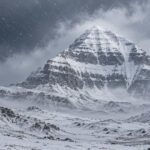
Even with those restrictions, the view is extraordinary. Unlike the Nepal side, where trekkers approach Everest through deep valleys and finally see the south face after many days on foot, the Tibet side opens toward the mountain across a broad, high valley. On a clear evening or sunrise, Everest appears huge, bright and almost architectural, with the north face filling the horizon above Rongbuk.
Tibet Side vs Nepal Side: Which Everest Base Camp Is This?
There are two famous Everest Base Camp journeys, and they are very different.
- Tibet Everest Base Camp: Reached mainly by road from Lhasa, Shigatse, Tingri or the Nepal border. The journey combines Tibetan monasteries, high plateau scenery, Himalayan viewpoints and Rongbuk Monastery. It is a cultural overland trip with high-altitude sightseeing.
- Nepal Everest Base Camp: Reached by trekking from Lukla through the Khumbu region. This is a multi-day hiking journey on the south side of Everest, usually taking around two weeks. See more Nepal Everest Base Camp.
If you want a serious trekking holiday, the Nepal route is the classic walking journey. If you want a shorter overland journey with Tibetan culture, monasteries, Himalayan road scenery and a direct north-face view of Everest, the Tibet route is the better fit.
Why the Tibet Everest Route Is Special
The road to Everest in Tibet is not just a drive to a mountain viewpoint. It is a journey through the historical heartland of central Tibet and into the high borderlands of the Himalaya.
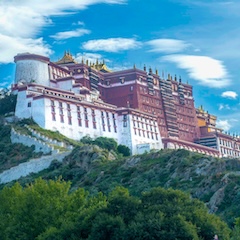
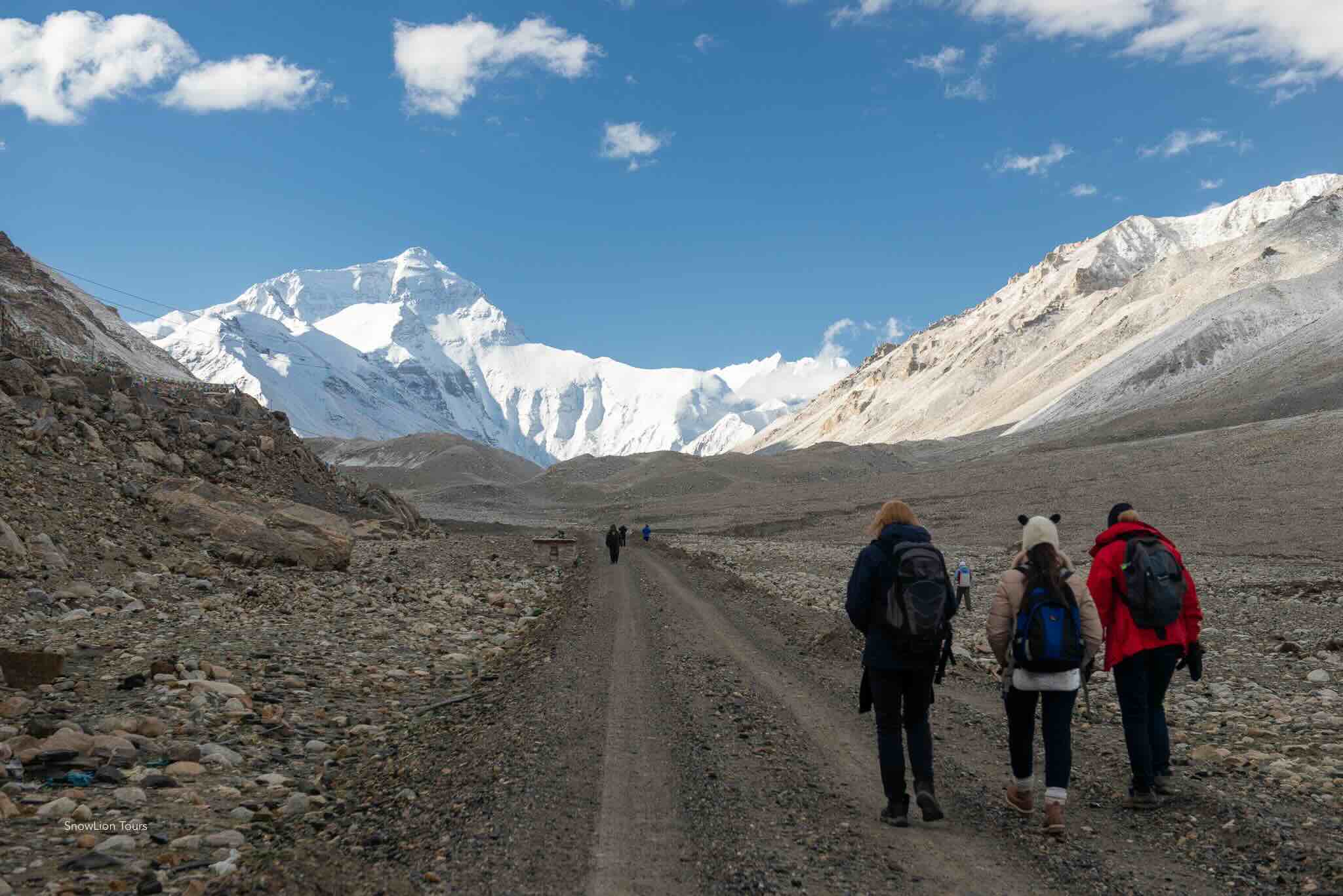
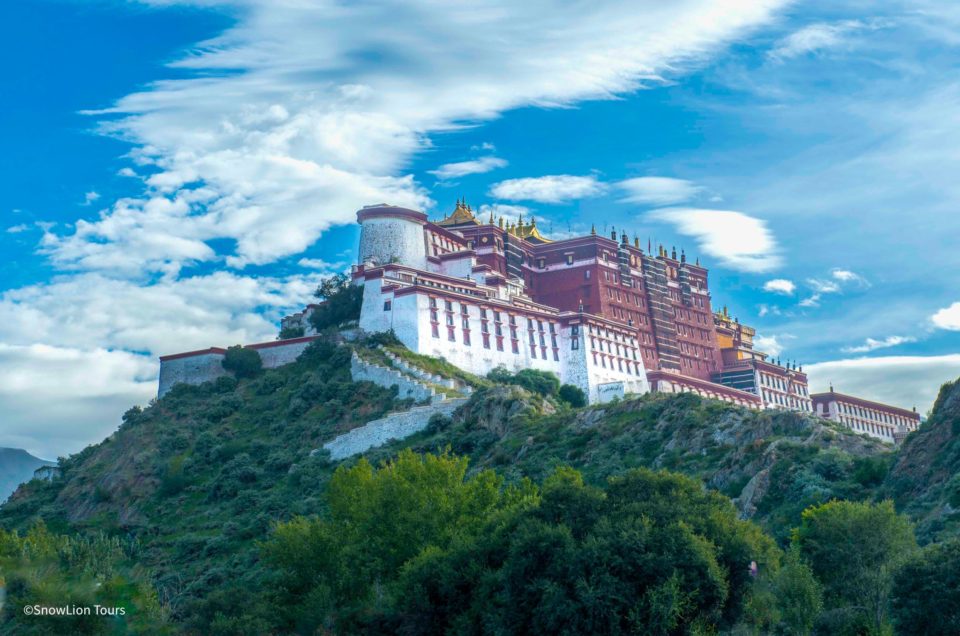
Most classic routes begin in Lhasa, where travelers spend time acclimatizing and visiting the Potala Palace, Jokhang Temple, Barkhor, Drepung Monastery and Sera Monastery. From there, the route usually crosses Yamdrok Lake, one of Tibet’s most beautiful turquoise lakes, continues through Gyantse and Shigatse, and then climbs toward the Everest region through high passes and open plateau country.
By the time you reach Rongbuk, you have not only seen Everest. You have crossed a large part of Tibet’s cultural landscape: old trade routes, farming towns, monasteries, glacier views, river valleys and the vast dry spaces that make the Tibetan Plateau feel so different from the lower Himalaya.
Classic Lhasa to Tibet Everest Base Camp Route
The most common Tibet Everest Base Camp route begins and ends in Lhasa, usually taking about 7 to 8 days. A comfortable itinerary moves gradually higher, which is important for acclimatization.
Day 1: Arrive in Lhasa
Arrive in Lhasa at around 3,650 meters and rest. The first day should be slow. Drink water, avoid alcohol, eat lightly and give your body time to adjust.
Day 2-3: Lhasa Sightseeing and Acclimatization
Visit the Potala Palace, Jokhang Temple, Barkhor, Drepung Monastery and Sera Monastery. These days are not just sightseeing days; they also help your body prepare for the higher altitude ahead.
Day 4: Lhasa to Gyantse and Shigatse
Drive over high passes toward Yamdrok Lake, continue past glacier and mountain scenery, then visit Gyantse and Shigatse. Many travelers visit Pelkor Chode and the Kumbum Stupa in Gyantse, then Tashilhunpo Monastery in Shigatse.
Day 5: Shigatse to Tingri, Rongbuk and the Everest Viewing Area
The road climbs through the western part of Tsang. On clear days, viewpoints near the passes can reveal a line of Himalayan giants. Depending on road conditions, permits, season and local access rules, travelers continue toward Rongbuk Monastery and the Everest viewing area.
Day 6: Everest Sunrise and Return Toward Shigatse
If the weather is kind, sunrise near Rongbuk is one of the best moments of the journey. After breakfast, most itineraries return toward Shigatse or Tingri. Some routes continue west toward Peikutso Lake, Kyirong and the Nepal border.
Day 7-8: Return to Lhasa or Continue to Nepal
Travelers on a round-trip route return to Lhasa through Shigatse, Gyantse and Yamdrok Lake. Travelers on an overland Tibet to Nepal route continue toward Kyirong and the border, depending on current border and permit conditions.
Altitude on a Tibet Everest Base Camp Trip
Altitude is the main challenge on this journey. The road route is not technically difficult, but it reaches very high elevations. A gradual itinerary is much safer and more comfortable than rushing directly from Lhasa to Everest.
| Place | Approximate Altitude | Travel Note |
|---|---|---|
| Lhasa | 3,650 m | Best place to acclimatize before going higher. |
| Gyantse | about 3,950 m | Historic town often visited between Yamdrok Lake and Shigatse. |
| Shigatse | about 3,840 m | Tibet’s second city and a useful overnight stop. |
| Tingri / Shegar area | about 4,300-4,350 m | Gateway region for Everest access. |
| Rongbuk Monastery | about 5,000 m | High-altitude monastery with a classic Everest view. |
| Everest viewing area | about 5,150-5,200 m | Very high, exposed and cold even outside winter. |
Because the journey reaches above 5,000 meters, travelers should take altitude seriously. Move slowly, keep warm, avoid overexertion, and tell your guide immediately if you develop strong headache, nausea, dizziness, breathlessness at rest, confusion or worsening symptoms. Oxygen can help temporarily, but descending is the most important response to serious altitude sickness.
Rongbuk Monastery and Everest’s North Face
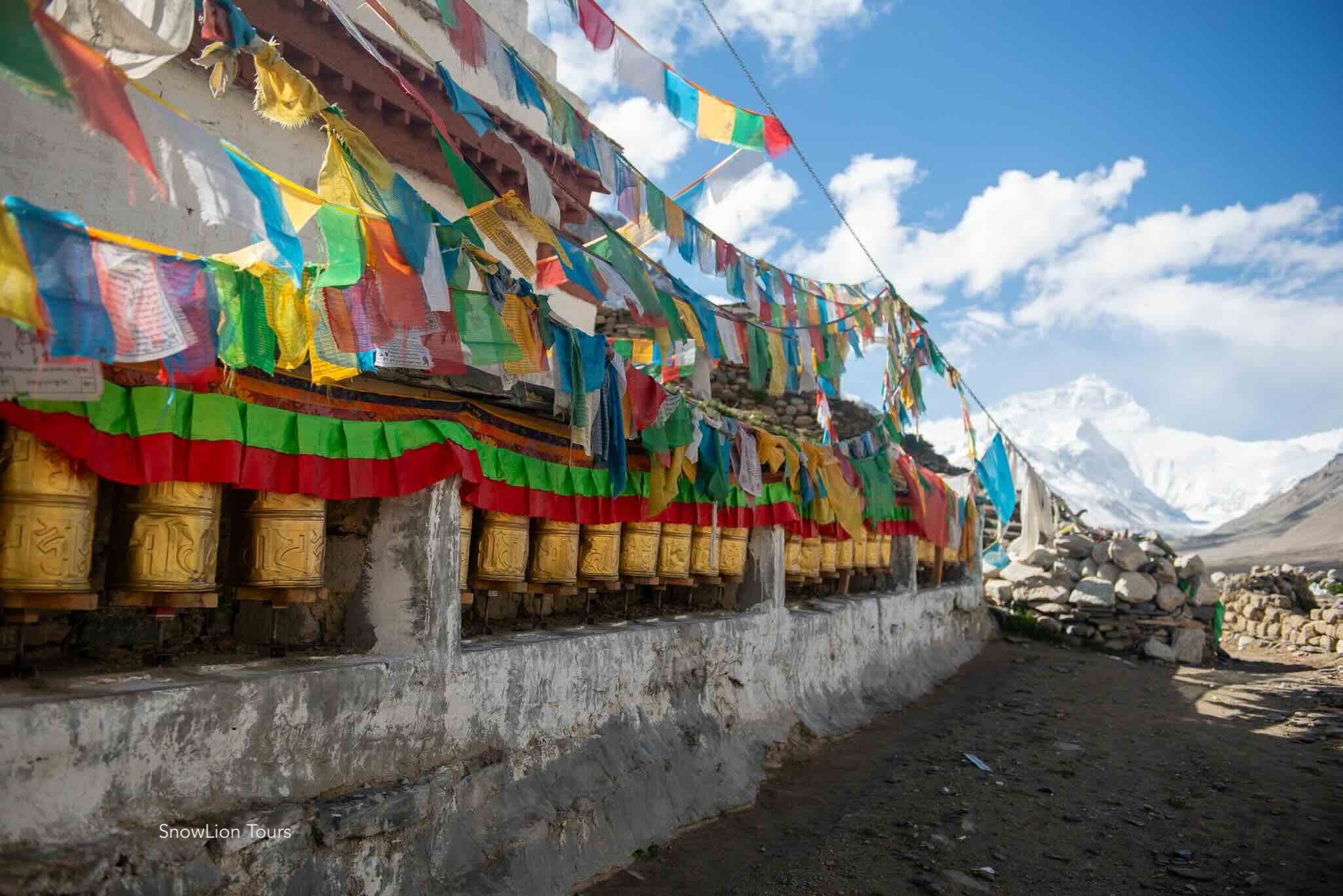
Rongbuk Monastery is one of the most memorable places on the Tibet Everest route. It stands in a wide valley below the north face of Everest, surrounded by dry mountains, prayer flags and views that feel much larger than any photograph can suggest.
The monastery has long been connected with hermits, meditation caves and early Everest expeditions from the north side. For Tibetan travelers, the mountain is not only a famous peak; it belongs to a sacred landscape of protector deities, pilgrimage routes, monasteries and prayer sites. For many visitors, this religious atmosphere is what makes the Tibet side feel so different from a simple mountain viewpoint.
On clear days, the classic view is from near Rongbuk, where the white stupa, monastery buildings and the triangular north face of Everest align beautifully. Sunset and sunrise are the most dramatic times, though weather decides everything. Clouds can hide the summit for hours or days, even in good seasons.
Permits Needed for Tibet Everest Base Camp
Foreign travelers cannot travel independently in the Tibet Autonomous Region. A Tibet Everest Base Camp journey must be arranged through a licensed travel agency, with a guide, vehicle and required permits.
For most Tibet Everest sightseeing trips, travelers need:
- Chinese visa: Needed if entering Tibet from mainland China. If entering from Nepal, travelers usually need a China Group Visa arranged through Kathmandu procedures.
- Tibet Travel Permit: Required for foreign travelers entering the Tibet Autonomous Region.
- Alien’s Travel Permit: Required for travel to certain areas outside Lhasa, including the Everest region.
- Border or frontier-related permission: The Everest region is close to the international border, so additional border-area permission may be required depending on nationality, itinerary and current regulations.
You should not try to arrange these documents at the last minute. Permit procedures, document requirements and processing times can change, especially around holidays, political meetings, winter restrictions or border adjustments. Send passport and visa details to your agency early and keep your itinerary consistent with the permits.
Best Time to Visit Tibet Everest Base Camp
The best seasons for Tibet Everest Base Camp are usually spring and autumn.
- April to early June: Often a good season for clear mountain views, comfortable daylight and strong visibility before the summer clouds build.
- September to October: One of the best periods for crisp skies, stable weather and excellent Himalayan views.
- July to August: Warmer, greener and popular for summer travel, but clouds and rain systems can hide Everest more often.
- November to February: Skies can be clear, but temperatures are severe and local access, accommodation and comfort are more limited.
Everest is never guaranteed. A perfect itinerary can still meet clouds; a short stop can sometimes get a completely clear mountain. If Everest is the main purpose of your journey, give yourself enough time and choose spring or autumn when possible.
Accommodation and Facilities Near Everest
Facilities in the Everest region are basic compared with Lhasa or Shigatse. Depending on the season and current local arrangements, travelers may stay near Rongbuk, in Shegar, Tingri or another approved stop. Rooms can be cold, simple and limited, and hot water, heating, Wi-Fi and private bathrooms should not be assumed unless confirmed.
Meals are usually simple: noodles, rice, soup, eggs, vegetables, Tibetan tea and basic Chinese or Tibetan dishes. Bring snacks that you know you can eat at altitude. Appetite often drops above 4,500 meters, so easy foods are useful.
How Difficult Is the Tibet Everest Base Camp Trip?
The standard Tibet Everest Base Camp journey is not a technical trek. Most of the route is by vehicle, with short walks at viewpoints, monasteries and towns. The difficulty comes from altitude, cold, long driving days and the remoteness of the Everest region.
This trip is suitable for many travelers in normal health, including travelers who do not want a long trek. However, it is not suitable for anyone who ignores altitude. Travelers with heart, lung, blood pressure or serious medical conditions should consult a doctor before planning a high-altitude Tibet route.
What to Pack for Tibet Everest Base Camp
- Warm down jacket or insulated jacket, even in warmer months.
- Layered clothing: base layer, fleece or softshell, windproof outer layer.
- Warm hat, sun hat, gloves and scarf or neck gaiter.
- Sunglasses with strong UV protection and high SPF sunscreen.
- Comfortable walking shoes with good grip.
- Personal medicine, altitude medication if prescribed by your doctor, and basic stomach medicine.
- Reusable water bottle or thermos.
- Power bank, camera batteries and memory cards.
- Passport, permit copies, visa documents and travel insurance details.
Photography Tips for Everest in Tibet
The best light is usually early morning and late afternoon. Sunrise can turn the north face gold, while sunset can bring long shadows across the Rongbuk valley. A medium zoom lens is useful for the monastery and mountain together, while a wide-angle lens captures the scale of the valley.
Cold drains batteries quickly, especially before sunrise. Keep spare batteries inside your jacket. Wind is common, so protect your lens from dust and use a steady hand or tripod where allowed.
Responsible Travel in the Everest Region
The Everest region is beautiful because it is fragile. Travel responsibly by taking all personal trash back with you, using toilets where available, avoiding plastic waste, respecting local rules in the nature reserve and listening to your guide when access points change.
At monasteries and religious sites, walk clockwise around Buddhist sacred places unless your guide tells you otherwise, ask before photographing people, and avoid loud behavior inside chapels. The goal is not only to reach a famous place, but to travel through it with respect.
Frequently Asked Questions
Can tourists visit Everest Base Camp in Tibet?
Tourists can visit the approved Rongbuk and Everest viewing area on the Tibet side with the correct permits and a registered tour. Ordinary visitors should not assume they can enter the climbers’ expedition base camp or protected core area, because those areas require separate permission and local rules can change.
How high is Tibet Everest Base Camp?
The tourist viewing area is commonly described as around 5,150 to 5,200 meters above sea level, while Rongbuk Monastery is around 5,000 meters. Exact stopping points may vary depending on local access rules, season and road conditions.
Do I need to trek to reach Everest Base Camp in Tibet?
No. The classic Tibet Everest Base Camp journey is mainly an overland road trip from Lhasa through Shigatse and Tingri to Rongbuk and the Everest viewing area. Short walks are possible, but it is not a long trekking route like the Nepal Everest Base Camp trek.
How many days do I need from Lhasa to Everest Base Camp?
Most travelers should plan 7 to 8 days for a comfortable Lhasa to Everest route. This allows time for Lhasa sightseeing, gradual acclimatization, Shigatse, the Everest region and the return journey. Faster trips are possible but are harder on the body.
What permits are required for Everest Base Camp in Tibet?
Foreign travelers usually need a Chinese visa or China Group Visa, a Tibet Travel Permit, an Alien’s Travel Permit and additional border-area permission for the Everest region. Your licensed Tibet travel agency arranges these according to your route and nationality.
When is the best time to see Mount Everest from Tibet?
April to early June and September to October are usually the best seasons for clear views. Summer is warmer but cloudier, while winter can be very cold and less comfortable, even when the sky is clear.
Can I travel from Tibet Everest Base Camp to Nepal?
Yes, some overland routes continue from the Everest region toward Kyirong and the Nepal border. This depends on current border conditions, visa rules, road conditions and permits, so it should be confirmed before the itinerary is finalized.
Everest Base Camp Tours We Offer
SnowLion Tours arranges private and group journeys to the Tibet side of Everest, including classic Lhasa round trips and overland routes toward Nepal.
- Incredible Everest – an 8-day Lhasa to Everest Base Camp route with Yamdrok Lake, Gyantse, Shigatse, Rongbuk and Everest views.
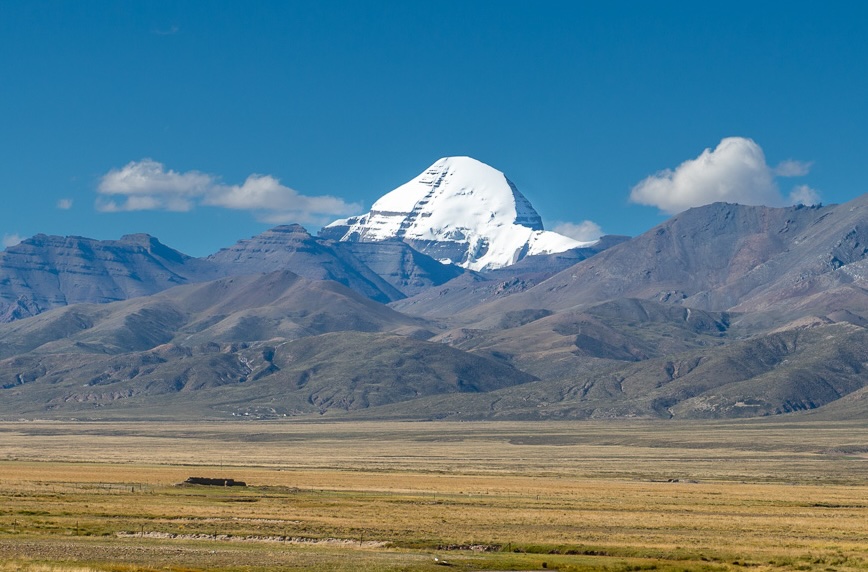
- Everest and Kailash Yatra – a longer journey that combines Lhasa, Everest Base Camp, Mount Kailash and western Tibet.
- Himalayan Journey – a Lhasa to Everest and Nepal border itinerary for travelers continuing across the Himalaya.
- Splendours of Tibet – a longer central Tibet and Himalayan route including Everest, Peikutso Lake and the Nepal border region.

.jpg "amdo monlam festival tour")