Xining, known as Siling in Tibetan, is the start of the Qinghai-Tibet Railway and the gateway to the Tibetan Plateau as well as the ancient Silk Road. It is the capital city of Qinghai Province in western China and the […]
Xining, known as Siling in Tibetan, is the start of the Qinghai-Tibet Railway and the gateway to the Tibetan Plateau as well as the ancient Silk Road. It is the capital city of Qinghai Province in western China and the largest city on the Tibetan Plateau. Xining has more than two million inhabitants and includes four districts and three counties: Huzhu, Huangzhong and Datong.
As the political and economic center of Qinghai Province, Xining is also considered the first city on the upper reaches of the Yellow River to reach a population in the millions. For travelers, Xining is one of the best places to land first because of Xining’s international airport. It has flights from many major Chinese cities, and the Qinghai-Tibet Railway, also known as the sky railway, starts from Xining.
The main ethnic groups living in Xining are Han, Hui, Monguor/Tu and Tibetan. Local traditions and customs are influenced by Tibetans, Monguor, Muslims and Han Chinese. Tibetans traditionally live in cold and humid high-altitude regions, cultivating highland barley and raising yaks, Tibetan sheep and goats. Mongolians live mainly by animal husbandry in cold and dry grassland areas. Han and Tu people settle in the Huangshui River Valley, where the climate is relatively humid and the land is flatter for agriculture. Hui and Salar people occupy the Yellow River Valley, with its drier environment and grasslands suitable for animal breeding.
The sites below can be visited as a Xining city tour if you do not have much time in the city. There are several Tibetan temples and monasteries in Xining, most of them located in the older part of town. Dongguan Grand Mosque is located in the Muslim quarter.
Qinghai Tibetan Medical and Cultural Museum, also known as Qinghai Tibet Cultural Museum, was built in 2006. The purpose of the museum is to collect, preserve, display and research Tibetan medicine, Tibetan traditional culture and history. Besides these halls, there is a famous Tibetan thangka painting on the second floor of the museum, which is one of the highlights of the museum.
Qinghai Provincial Museum is worth a visit for its collection of relics, including Mongolian pottery, Tibetan mani stones, bronze coins from the Han dynasty and exhibitions on traditional clothing and architecture from minority ethnic groups in Qinghai, including Tibetans, Mongolians, Hui, Tu and Salar. The museum has also had periods of construction and renovation, so opening conditions should be checked locally.
The Northern Mountain Taoist Temple is the oldest religious building in Qinghai Province and one of the important cultural relic protection sites in China. Because of its Buddhist and Taoist architectural styles and unique Taoist culture, the temple is praised as a bright pearl on the southern path of the Silk Road. The buildings were constructed from west to east, with huge rocks above and a deep valley below, making the temple appear as if it is hanging in the sky. It is sometimes described as the second largest hanging temple in China.
Khepa Misum Lhakhang, also called Dafo Temple, was built to commemorate the place where Mar Shakyamuni and his two colleagues maintained the Tibetan monastic tradition and finally passed away during the persecution of Buddhism in central Tibet by Langdarma. The temple formerly contained images of the three great monks, and one small section was rebuilt in the mid 1980s.
In the seventh century AD, Princess Wencheng stayed at the original site of this temple for one month when she entered Tibet. Hongjue Temple was built in the seventh century AD, and it is said that it was built even before Qingtang city. During the reign of Qianlong, when the sixth Panchen Lama was invited to Beijing, he lived in this temple. Emperor Qianlong bestowed the temple on the sixth Panchen, and since then it has become an important Buddhist site for successive Panchen Lamas stationed in Qinghai.
Dusum Nyiwo Temple, known as Jintasi in Chinese, is located next to Hongjue Temple. It was founded in 1390 and is also a branch of Kumbum Jampaling Monastery. The temple mainly contains the Buddhas of the three times, flanked by other small statues.
Dongguan Mosque in Xining is one of the largest mosques in northwest China, with a history of more than 600 years. Its architecture combines traditional Chinese style and local features. A three-story modern building stands between the gateway and the street to house the mosque administration. The mosque is not especially Middle Eastern in style, but rather closer to Chinese folk architecture. Beyond the square, the large domed hall can hold many worshippers and is an important Islamic education center in Qinghai Province.
Nanshan Park is located on Nanshan Mountain south of Xining City at around 2,419 meters above sea level. It covers a large area and is the largest modern mountain forest park in Xining. Officially opened in 1999, the park includes mountain forest walking areas, scenic viewpoints, children’s areas, leisure spaces and Tibetan cultural areas. It is a good place for city views and relaxed sightseeing.
Xining also has many places to explore near the city itself, usually around 100 to 150 kilometers away. Many of these sites can be visited as a day trip or short two-day trip from Xining. Below are some of the most interesting places nearby.
Kumbum Monastery is located about 25 kilometers west of Xining. One of the six great monasteries of the Gelugpa school of Tibetan Buddhism, Kumbum is famous as the birthplace of the great religious reformer Tsongkhapa. It is a wonderful place to experience Tibetan religious culture, architecture and art. Highlights include butter sculptures, monastic debating and a chapel housing a sandalwood tree said to have grown from the umbilical cord of Tsongkhapa.
Kanbula National Forest Park is located in Jianzha County about 105 kilometers south of Xining. The park features impressive peaks, mountains, caves, cliffs, red stone columns, forests and turquoise rivers. Achung Namdzong Nunnery is located in a valley inside the park, and visitors can climb to ancient Buddhist temples and small caves with Buddha statues.
The historically important site of Malho Dorji Drakra Namdzong is located inside Khamra National Park. During the eighth century, this sacred abode was entrusted by Padmasambhava to the protector deity Mesang, and it is revered as one of the 25 important power places of Kham and Amdo, symbolizing the mind aspect of awakened mind.
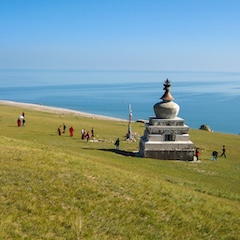
Qinghai Lake is in Hainan Tibetan Autonomous Prefecture, about 150 kilometers west of Xining. The largest lake in China, Qinghai Lake is regarded as holy by Tibetans and Mongolians. On the south side of the lake, visitors can enjoy the turquoise water, ride horses along the shore and experience Tibetan nomad life. With an extra day, travelers can continue to the northwest side of the lake and visit bird habitats where migratory species gather in season.
Qutan Monastery is in Ledu County, about 90 kilometers east of Xining. Formerly known as Drotsang Lhakhang Gautamde Gegye Dechenling, it is sometimes called the “Little Forbidden City.” This remarkably symmetrical temple complex, built in a Sino-Tibetan style, dates from 1392 and originally belonged to the Karma Kagyu school. Because of its design, it is an important study site for archaeologists and specialists in ancient architecture.
Huzhu Beishan Park is located in Huzhu County, about 145 kilometers east of Xining. The park has many sights for nature lovers and trekkers, including forests, streams, waterfalls, ponds and sacred stupas. For travelers interested in hiking, there are routes toward high mountain lakes at around 3,700 meters.
Gonlung Monastery lies in Huzhu County about 65 kilometers east of Xining. Located in evergreen forest below snow mountains, Gonlung Jampaling is a quiet monastery that receives relatively few tourists. It is a pilgrimage site along the northern Zongchu River and is associated with visits by the third and fourth Dalai Lamas on their way to Lhasa. The area has good hiking, and the monastery preserves interesting thangka paintings.
Shadzong Monastery is in Ping’an County, about 30 kilometers east of Xining. Below Mount Amnye Gyeli, the hermitage is associated with the Chinese pilgrim Faxian, who passed through the area on his way to India in 399 AD. Later, in 1359, the fourth Karmapa Rolpei Dorji visited the site and conferred vows on Tsongkhapa here.
Shachung Monastery is located in Hualong County about 120 kilometers east of Xining. Perched on a mountain ridge shaped like the mythical Garuda bird, Shachung is one of the great monasteries of the Gelugpa school in Amdo. Built in 1349, it is one of the oldest monasteries in eastern Tibet. From its mountain setting, visitors can walk along the ridge with views of Tibetan farming fields on one side and a steep cliff above the Yellow River on the other.
Laji Mountain, or Dzongkar Latse, lies south of Xining about 60 kilometers away. A branch of the Qilian Mountains, it stretches from west to east with high peaks and important passes. The Laji Mountain Pass, at about 3,820 meters, is an important route toward Golok and Tongkor. It is one of the most distinctive scenic mountain areas within a short driving distance from Xining.
This cave-style temple is located about 10 kilometers east of Xining. During the ninth century, when Buddhism was persecuted in central Tibet by King Langdarma, the three monks Mar Shakyamuni, Tsang Rabsel and Yo Gejung fled to Amdo, where they maintained the monastic lineage. They lived for some time at Martsangdrak and passed away in Xining.
Explore more! Join to get updates on Tibet tours and departures.
Explore the cultural and nomadic heartlands of undiscovered Eastern Tibet. Journey to the shores of stunning turquoise lakes, visit nomadic herders tending yaks and sheep, and enjoy a picnic among blooming yellow wildflower fields. Take …
Trek around sacred Mt. Amnye Machen through red clay mountains, Yellow River valleys, nomad camps, monasteries, and high plateau landscapes.
Journey across Amdo & Kham Tibet from Xining to Chengdu. Visit Qinghai Lake, Amnye Machen, Yushu, Dzogchen, Derge, Ganzi, Lithang & Danba’s Tibetan villages.